Double Extra Point has moved!

You should be automatically redirected in 5 seconds. If not, visit
www.doubleextrapoint.com
and update your bookmarks.

Wednesday, September 27, 2006

Sammy Vegas - NFL "N"sider #6


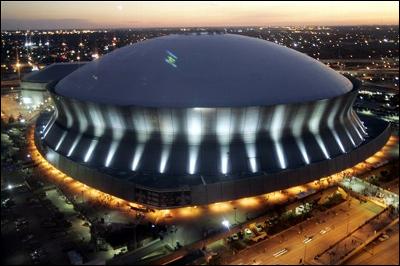
Last week was an incredible week in the NFL. We saw teams such as Chicago (3-0), Carolina (1-2), and Baltimore (3-0) win in the final minutes of their games. We also saw teams such as Houston, Tennessee, Detroit, Oakland (had a bye which could be considered a victory), and Tampa Bay remain winless. However, most importantly, we saw football return to the Big Easy. It is easy to say that the $85 million dollars to repair and renovate the Superdome could have been spent elsewhere, such as to rebuild communities and restore damaged businesses. But with the NFL bringing in 8 games a year, Tulane playing 6 games a year, the Sugar Bowl, all of the various concerts, conventions, and events a year, it is a crucial investment. For now though, put all of the financial details aside and think about the real reasons why the Superdome had to be renovated: Morale. Hurricanes. Burlesques. Beads. Po’ Boys. Jambalaya. Mardi Gras 2007!

Josh Brown (K): After taking an early 35-3 lead over the NY Giants, the Seattle Seahawks were not in need of any late game heroics from Brown. He ended up hitting 6 of 6 extra points in a 42-30 win in which we saw the Giants make another incredible late game rally. Here’s an idea for the Giants: move your clocks ahead two hours so you are not always starting in the 3rd quarter.
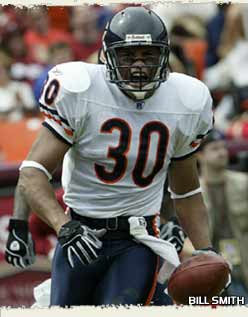
Mike Brown (S): Brown saved the day for the undefeated Chicago Bears. Against the Vikings, the Bears were down 16-12 late in the 4th quarter when Brown forced a fumble that lead to the game-winning touchdown with under 2 minutes to play. The Bears are now 3-0 against the NFC North and appear to be ready for a title run with unusual offensive output.

Ralph Brown (S): In a heartbreaking loss to the Baltimore Ravens’, the Browns’ DB recorded only one tackle.

Correll Buckhalter (RB): In a dominating 38-24 victory over the San Francisco 49ers, the Eagles’ Correll Buckhalter produced just 16 yards on 5 carries. The Eagles’ other back, Brian Westbrook, had 117 yards rushing, 48 yards receiving, and 3 touchdowns and in case you were wondering, Buckhalter won’t be starting next week.

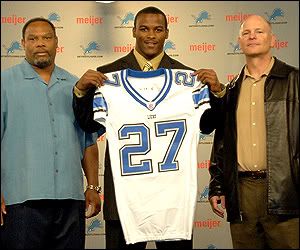
Daniel Bullocks (S): In another pitiful performance by the Detroit Lions, Bullocks again looked sharp with 4 tackles and 2 assists. Even though they are winless, the Lions players surely can’t complain about the fact they live in one of the most beautiful cities in the country where the sun shines everyday and the downtown area resembles Hiroshima.

Josh Bullocks (S): In case you haven’t heard yet, the New Orleans Saints are undefeated at 3-0 and appear to be legit. On Monday Night Football, the Saints dominated a tough Atlanta Falcons team 23-3. Bullocks had a magnificent blocked field goal and added 5 solo tackles and 2 assisted tackles.

Scott Shanle (LB): Along with Bullocks and the rest of the New Orleans Saints, Shanle shined on MNF. He added 4 tackles and 1 sack and watched his fellow defense hold the run-oriented Falcons to only 117 yards rushing.

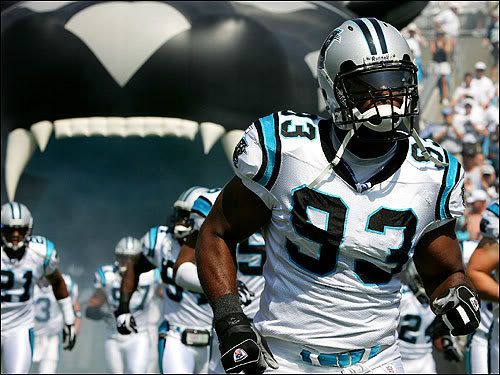
Mike Minter (S): The Carolina Panthers narrowly missed going a fate-sealing 0-3 start to this early season by beating Tampa Bay 26-24 on a last second field goal. Minter added just one solo and one assisted tackle.

Mike Rucker (DE): Along with Minter and the rest of the Carolina Panthers, Rucker could breathe a huge sigh of relief last Sunday. Rucker chipped in with one tackle and 2 assists as the 1-2 Panthers edged out Tampa.

Ahman Green (RB): Ahman had a fantastic day for the Packers as they beat the hapless Lions. Green had 63 yards on the ground and 68 yards receiving with one touchdownand now appears to be healthy and ready to contribute for the first time in years.

Chris Kelsey (DE): Kelsey and the Buffalo Bills fell to 1-2 after last week’s embarrassing home loss to the New York Jets. Kelsey had one solo, one assisted tackle, and a sack in the loss.

Kyle Larson (P): I’ll continue to stand by my claim that the Cincinnati Bengals are the best team in the NFL. After systematically destroying the World Champion Steelers despite numerous setbacks throughout the game, the Bengals sit 3-0 and appear to clicking on all cylinders – including punting. Larson had 5 punts for an average of 53.4 yards, including a long of 67 yards.

Sam Koch (P): Down 14-3 in the 4th quarter to the Cleveland Browns, the Baltimore Ravens won 15-14 on a last second field goal from Matt Stover to remain unbeaten. Koch did his part and had 6 punts for an average of 39.2 yards, including a long of 53 and 3 inside the 20. Have we become “Punter U”?

Barrett Ruud (LB): Ruud is starting to see some significant playing time as the young season moves on. Barrett recorded 8 tackles for the 0-3 Tampa Bay Buccaneers.

Kyle Vanden Bosch (DE): In a battle of two winless teams, Vanden Bosch and the Tennessee Titans were edged out by the Miami Dolphins 13-10. Kyle recorded 3 solo tackles, one assisted tackle, and one sack and will have the unfortunate task of watching, Kerry Collins once again line up under center next week. What’s that one QB’s name again? Oh yeah, Vincent Young. It has to feel like he is watching Chance Mock play ahead of him all over again.

Fabian Washington (DB):
My Dear Lord,
Thank you for giving the Oakland Raiders a week off. I pray that if you could find it in your heart to give them the rest of the season off, it would give us all a few minutes of our lives back each week by not having to read about them.
Amen.

Demorrio Williams (LB): Demorrio had another great game for the Falcons on Monday night by contributing 7 tackles and 1 assist against the Saints. However, Williams gameplay was overshadowed by the homecoming of the Saints to the city of New Orleans and to the Superdome.

Tuesday, September 26, 2006

By the Numbers

There is no arguing that Nebraska is a much better team through four games than a year ago. A quick glance at the NCAA statistics provides further evidence of this improvement.

Offense

Total Offense: #6 with 472.5 yards/game.
Rushing Offense: #10 with 224.25 yards/game
Passing Offense: #26 with 248.3 yards/game
Scoring Offense: #2 behind Louisville at 42.8 points/game. Nebraska leads the nation with 24 touchdowns.

Defense

Total Defense: #21 giving up 257.8 yards/game
Rushing Defense: #49 giving up 111.00 yards/game
Passing Defense: #17 giving up 146.8 yards/game
Scoring Defense: #15 giving up 11.8 points/game

Best Individual Numbers - Zac Taylor

QB Rating: #3 nationally at 178.3
Touchdowns: Tied for 15th nationally with 8

Most Surprising Statistics

In the battle of Big 12 sophomore running backs:

Player.............G....ATT....YDS......AVG....TD......ATT/G.....YDS/G
Marlon Lucky.......4....51.....365.....7.16.....5......12.75......91.25
Jamaal Charles.....4....55.....334.....6.07.....3......13.75......83.50

And, after leading the nation in sacks with 50 in 2005, the Huskers have managed just 7 sacks in 4 games in 2006.

Monday, September 25, 2006

BlogPoll Ballot - Week 4

Ok, have at it. Missouri makes its first appearance along with Boise State and Rutgers. As you can probably see, this was apparently "Separation Saturday" for the bottom fourth of my poll. I'm accepting any and all feedback on this one. My petition to have my girlfriend move her birthday to basketball season was denied. As a result, I watched virtually no college football this weekend.

RankTeamDelta
1 Ohio State --
2 Southern Cal --
3 Auburn --
4 West Virginia --
5 Louisville --
6 Florida --
7 Michigan --
8 Texas --
9 Georgia --
10 Louisiana State --
11 Oregon --
12 Iowa 1
13 Notre Dame 1
14 Tennessee --
15 Virginia Tech --
16 TCU --
17 Oklahoma 1
18 Cal 1
19 Clemson 2
20 Florida State 2
21 Nebraska 2
22 Missouri 4
23 Boise State 3
24 Rutgers 2
25 Boston College 5

Dropped Out: Arizona State (#17), Alabama (#24), Penn State (#25).

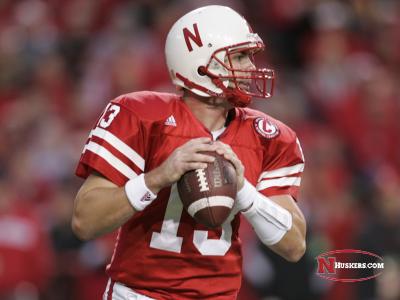
Kansas Preview


Location: Lawrence, Kansas
Enrollment: 29,272
Conference: Big 12
Stadium: Memorial Stadium (Capacity: 50,071)
First Year of Football: 1890
All Time Record: 539-532-58

Head Coach:Mark Mangino
Fifth year as head coach at Kansas: Career record 22-30

· Mangino spent 8 seasons as an assistant at Kansas State. He served as recruiting coordinator, running game coordinator and, in 1998, was appointed assistant head coach. The season prior to his arrival in Manhattan, the Wildcats posted a 5-6 record. Over the next eight seasons, K-State went 71-23-1 with six consecutive nine-plus win seasons and played in six straight bowl games.
· In Mangino’s four seasons as coach of Kansas, the Jayhawks have made two bowl appearances.
· Mangino has seen two of his signees named Big 12 Offensive Newcomer of the Year during his short tenure at KU - quarterback Bill Whittemore in 2002 and center Joe Vaughn in 2003.

Team Overview

Last Season: The Jayhawks finished the 2005 season with a 7-5 record. In addition, they defeated the University of Houston in the Fort Worth Bowl 42-13. The 2005 season also saw Kansas post a perfect 6-0 record at home - the team's first undefeated/untied season at home since 1951.

This Season: Kansas comes into the game with a 3-1 record. Their lone loss was an overtime thriller to Toledo.

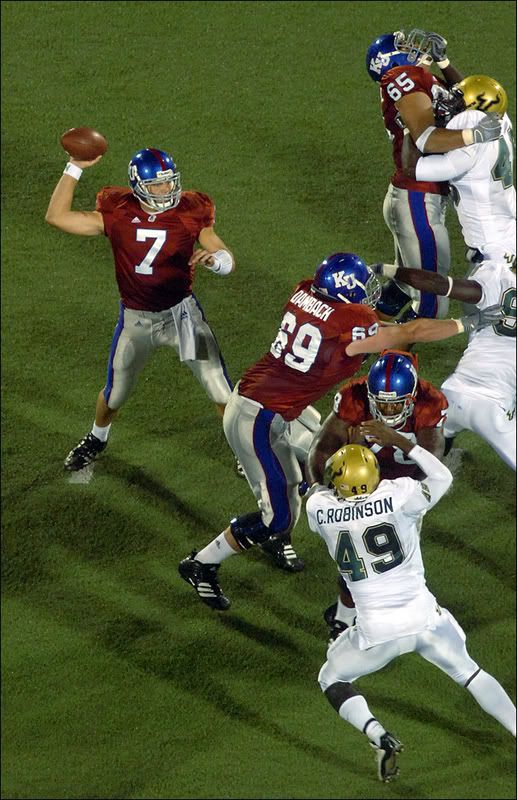
On Offense: Offensively the Jayhawks are averaging 363 yards per game in 2006. Kansas may be in the midst of a minor quarterback controversy. Redshirt freshman Kerry Meier started the first three games before injuring his arm against Toledo. Against South Florida senior Adam Barmann got the nod and completed 25 of 35 throws for 273 yards and no interceptions. It is unclear whether Meier will be able to go against the Huskers, but look to perhaps see both quarterbacks on Saturday. At RB KU is led by Jon Cornish. The 205 pound senior is averaging over 100 yards per game this season. Cornish has a nice burst when holes are there and also has the hands to be successful catching passes out of the backfield. Receiver looked to be a weakness going to into 2005, but so far players have stepped up to carry the load. The Jayhawks rely mainly on Brian Murph and Marcus Henry. In addition, sophomore Dexton Fields looks like a star in the making and has two TD catches this year. The KU offensive line might be the best of Mangino’s tenure. Senior guard Bob Whitaker anchors the line and is also the biggest of KU’s linemen. Sophomore tackle Anthony Collins is another of the team’s rising stars.

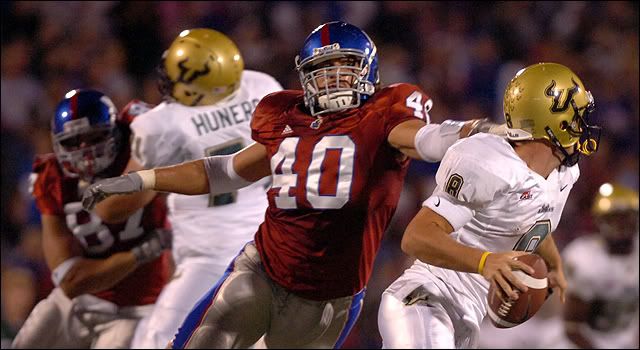
On Defense: In 2005, the Jayhawks’ defense was central to the team’s success. This far in 2006, the team is ranked 45th nationally against the run and 54th against the pass. The team’s best defensive player is CB Aqib Talib. Talib is a hard-hitting DB who shines in making tackles in the open field. Unfortunately for the Jayhawks Talib was suspended for the first two games in 2005. Talib is joined in the secondary by SS Jerome Kemp who is a ferocious hitter. Kemp is fourth on the team with 21 tackles. The Jayhawks’ leading tackler is sophomore M LB Mike Rivera. Rivera will be key in KU’s efforts to stop Nebraska’s power running game. Joe Mortensen is another talented linebacker who has 6 tackles for loss in 2006. Along the defensive front the Jayhawks are led by defensive end Paul Como. Como is the team’s top pass rusher and leads the team with 3 sacks. Defensive tackle James McClinton is also a future star along KU’s front four.

Special Teams: Kicker Scott Webb is 2-3 on the year after earning honorable mention All-Big 12 in 2005. Considered one of the better punters in the country, Kyle Tucker is struggling in 2006, averaging less than 40 yards per punt. Punt returner Brian Murph is dangerous averaging 21 yards per return, including a 70 yard touchdown.

Random Notes

Series History: This marks the 113th meeting between the two teams. Nebraska leads the all-time series 87-22-3.

I Can’t Believe I Looked It Up Either: Last season the Jayhawks broke a 36 consecutive game losing streak to the Huskers. Prior to last year, Nebraska had not lost to KU since a 23-13 defeat in Lawrence in 1968. The Huskers bounced back from that loss with a 21-17 victory of the Jayhawks in Lincoln in 1969.

Way Cooler than “Husker – Power”: The "Rock Chalk" chant dates to 1866, when it was adopted by the Kansas University Science Club. At first, the cheer was "Rah, Rah, Jayhawk, KU" repeated three times. Later, an English professor suggested "Rock Chalk," in place of "Rah, Rah" because it rhymed with Jayhawk and because it was symbolic of the limestone, also known as chalk rock, surrounding Mount Oread, the site of the Lawrence Campus. It became the official cheer of the University in 1897.

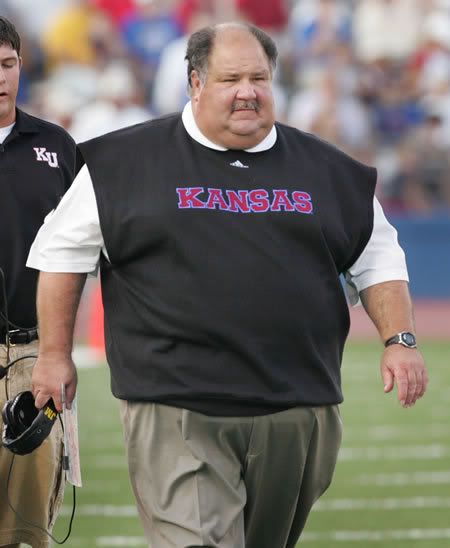
Obligatory “Mark Mangino is Fat” Comment: Mark Mangino is so fat, his blood type is Ragu. Mangino reportedly weighs upwards of 420 pounds this season. Coincidentally his career winning percentage is .423. The over-under on his cholesterol level is 520.

Six Degrees of Beano Cook: Beano doesn’t have to work real hard on this one. In 2005 Kansas beat Nebraska 40-15.

Sunday, September 24, 2006

Great game, but I didn't see a play...


I apologize for the lack of updates this weekend. I spent the weekend in Galveston and was forced to acquire updates on the Nebraska game via my cell phone. Have I mentioned that I despise the Big 12 television contracts? Stay tuned for another big week of coverage, including analysis of the Troy game, a preview of the Jayhawks and our regularly scheduled programming.

Friday, September 22, 2006

Take the Double Extra Points - #3

“No wife can endure a gambling husband, unless he is a steady winner”

2 weeks ago: 3-5 ATS
Last week: .29% BAC (Blood Alcohol in California)
Season: 8-8-1 ATS

I apologize for taking a sabbatical last weekend, but a more important Nebraska football game suddenly came up. I’ll admit two weeks ago our selections weren’t exactly refrigerator material. In fact, a losing record is a topic that we do not expect to encounter again. However, as you can see, the Double Extra Point fan club is still behind us and stronger than ever. After encouragement like that, who isn’t ready for a rebound?

I will say that some last minute scratches two weeks ago, like Drew Tate for Iowa and Blake Powers for Indiana, no doubt changed the outcome of games significantly and did little to help our record. In addition, why is Tyrone Willingham no longer coaching at Notre Dame? This is why. Down 24 points to Oklahoma with 5 minutes to go, Willingham’s Washington Huskies drove the length of the field and eventually scored a TD to put them down18 points. Instead of attempting a two-point conversion to bring his team within 2 possessions at 16 points (two TD’s and two 2-pt conversions), Willingham kicks the extra point to make it 17 points (spread was 17.5). Washington then proceeds to regain possession of the ball with less than 4 minutes to play, but instead of being down 2 possessions, were still down 3 possessions giving his squad no chance to win.

We absolutely love our selections this week. If you are interested in becoming famous and marrying beautiful women like these other professionals, then stick with us. Like my dad taught me, if you truly think you are wise and bold enough to predict the outcome of a game, then show me. And believe us, after hours of research we will show you.

REMEMBER - ALL INFORMATION PROVIDED ON THIS WEB SITE IS FOR NEWSMATTER AND ENTERTAINMENT PURPOSES ONLY AND IS NOT INTENDED TO VIOLATE ANY LOCAL, STATE, OR FEDERAL LAWS. It is braggadocio we endorse - not gambling.

Jeffie Husker

Wake Forest (+3) over Ole Miss: Wake Forest is off to a great start at 3-0 – their best in 19 years. In fact, it is safe to say that they are not only the biggest surprise of the ACC but the only surprise. QB Riley Skinner has not committed a turnover this year and they have had solid play from their backfield. Ole Miss lost their SEC opener last week to the perennial power Kentucky, and the week before, tallied only 162 yards when they were smoked by Missouri. Last week, Ole Miss committed 5 turnovers and QB Brent Schaeffer is averaging only 126 yards/game with 4 picks on the year. Wait, does that say that Wake is getting points? Look for the outright win.

Air Force (+1/2) over Wyoming: Even though they have played only one game this year, Air Force gained 400 yards and came up short on a late 2 point conversion to lose to Tennessee in Knoxville. They bring their wishbone offense to Wyoming, which has artificial turf (the Falcons are 13-2 ATS on turf). Wyoming is only 1-2 this year, but they have a solid defense that held Boise St. to only 17 points. However, the OL has given up 9 sacks this year, and faced with the daunting task of preparing for the wishbone only one week after preparing for a spread offense, is going to be too much for the defense to handle. Air Force wins this one easily.

Oklahoma State (-1.5) over Houston: This game is going to feature two potential NFL QB prospects that can put points on the board. Houston’s veteran QB Kevin Kolb has lead his team to a 3-0 start by averaging almost 300 yards/game and throwing for 8 scores. Oklahoma State relies on QB Bobby Reid, who despite his youth, leads a spread offense that is loaded with talent. Houston must travel to Miami next week, and OSU will have many alumni and many travelers at the game. This one should be interesting, and Husker fans take notice because we must defend this spread offense in Stillwater on October 28.

Dr. D


South Carolina (-31) over Florida Atlantic: Florida Atlantic has been outscored this year 147-14. They were beat 48-8 last week against Oklahoma State. They are in the bottom 10 statistically in offense and defense. Enough said. South Carolina has their QB Blake Mitchell back this week after serving a suspension for a bar fight. Drunk or not, Spurrier will let Mitchell utilize all of his offensive weapons and will use this game as a springboard for confidence as they have Auburn on deck. Look for Spurrier to take full advantage of the opportunity to run up the score…again.

Iowa (-21.5) over Illinois: It appears as if this could be a huge trap for Iowa, as they are coming off a win over Iowa State and have Ohio State next Saturday night. However, Drew Tate is back and is averaging 249 yards/game while completing 62% of his passes. Illinois is starting a true freshman QB named Juice Williams. Iowa has too much talent and remember, Illinois was blown out by Syracuse last week. Iowa will not burn us this time.

Nebraska (-23) over Troy: This is 3rd straight road game for Troy as they have come off two heart breakers against Florida State and Georgia Tech. They are 0-3 against Nebraska and have only one win all-time against Big 12 teams. Look for Zac Taylor and his 73% completion percentage to rebound this Saturday night at home as the Big 12 opener with Kansas looms on the horizon. Callahan will once again return to the air and Nebraska will use the home crowd advantage to roll big.

Sammy Vegas

California (-7.5) over Arizona State: After an embarrassing first week loss to Tennessee, Cal appears to be focused and ready to take on the Pac 10. RB Marshawn Lynch is averaging over 7 yards/carry this year and is coming up against a porous front seven from Arizona State. Both offenses are amongst the best in the country, but Arizona State under Dirk Koetter has never won a game in the state of California. This is the first of 3 extremely difficult road games for Arizona State, and you heard it here, Cal will win the Pac 10 this year.

Boston College (-7.5) over N.C. State: B.C.’s two wins this year have both been at home and in OT. However, B.C. thrives on the road and is an impressive 18-8 ATS on the road. They are well coached and possess a wealth of talent at the running back position as well a great QB in Matt Ryan, who has been playing injured and is now at almost full strength. Last week against S. Mississippi, N.C. State did not force one punt. Chuck Amato could possibly be in his last year as head coach, and his team has already dropped two non-conference games to Akron and S. Miss.

Missouri (-21.5) over Ohio: The Missouri Tigers are off to a great start this year led by a talented offense. RB Tony Temple is averaging over 7 yards/carry and QB Chase Daniel is completing 67% of his passes with 7 TD’s and 1 INT. Ohio is 2-11 ATS their last 13 road games and is clearly outmatched offensively and defensively here. Missouri has 18 starters back, has numerous NFL talents, and is looking at going 5-0 for the first time since 1981. With the nightlife and margarita specials too much to pass up, expect coach Frank Solich and his Bobcats to have a massive hangover in the great party town of Columbia.

Thursday, September 21, 2006

Sammy Vegas - NFL "N"sider #5


Although only a few days have elapsed since the USC – Nebraska game, I hope you all have been able to gather your composure and move on as I have. The NFL season is off to precarious beginning with many twists and turns. If you haven’t noticed, the Atlanta Falcons have compiled 558 yards rushing and only 209 yards passing in two impressive wins over the formidable defenses of the Carolina Panthers and Tampa Bay Buccaneers. Watching Michael Vick and Warrick Dunn run the option surely brings smiles to faces of NU football purists. On the other hand, the Carolina Panthers (many experts’ pick to win the NFC), as with a weekend with me and the ladies, are off to a 0-2 start. Although, there were no game breaking or standout performances by ex-Huskers in the NFL, there were some great contributions. Even though I was drinking Jack and Cokes on Sunday afternoon in a California airport with my NFL ‘N’sider consultants and fan club, I was still somehow able to note some great performances by Huskers in the NFL.

Josh Brown (K): With just 3 extra points and no field goals in Seattle’s 21-10 over the Arizona Cardinals, Brown was not exactly the star of my fantasy team. However, the Seahawks do sit alone in top place in NFC West at 2-0.

Mike Brown (S): Once again the Chicago Bears look like they perhaps have the best defense in the NFL. Brown contributed 2 tackles in the teams’ second blowout win of the season, but it should be noted that those 2 wins are against Detroit and Green Bay.

Ralph Brown (CB): Brown had 2 tackles in Cleveland’s 34-17 loss to the Cincinnati Bengals.

Correll Buckhalter (RB): With only 6 rushes for 6 yards, Buckhalter saw his Eagles blow a 17 point fourth quarter lead and lose in OT to the Eli Manning lead New York Giants.


Daniel Bullocks (S): Even though Detroit WR and former Texas Longhorn Roy Williams has voiced that the score does not matter to him, Bullocks did his part to try and help the Lions versus the Chicago Bears. Bullocks lead the team with 7 tackles in a 34 – 17 loss.

Josh Bullocks (S): With 2 tackles in a shootout win over the Green Bay Packers, surely Bullocks and his teammates are focused on next Monday night when the Saints return home to the Superdome.

Scott Shanle (LB): Shanle contributed 4 tackles, 3 assists, and 1 FF alongside Bullocks in the Saints win last Sunday.

Mike Minter (S): With 6 tackles and 2 assists in a 16-13 loss to the undefeated Minnesota Vikings, Minter and the Carolina Panthers (many experts’ picks to win the NFC) are still winless.

Mike Rucker (DE): Along with Minter and the rest of the Panther’s defense, Rucker struggled with only 2 tackles and 1 assist.

Ahman Green (RB): Finally, Brett Favre and the Packers showed that they might win a game this year as they put up 27 points in a loss to the New Orleans’ Saints. However, Green had only 16 rushes for 42 yards.

Chris Kelsey (DE): Kelsey had 2 tackles and 1 sack against Miami in a 16-6 win for the Buffalo Bills.

Kyle Larson (P): In a 34-17 win over the Cleveland Browns, the Cincinnati punter had 48 yards on 4 punts.

Sam Koch (P): Koch and the Baltimore Ravens won 28-6 over Raiders and have established their team as legit AFC contenders. Koch added 7 punts for 43 yards/punt, including 3 punts inside the 20.

Kyle Vanden Bosch(DE): In a 40-7 loss to the Chargers, Kyle had 3 tackles for the Tennessee Titans who apparently playing touch-football. The only question regarding the Titans next week is whether we will see the first start of QB Vincent Young – because the season is clearly over.

Fabian Washington (CB): With a 28-6 loss to the Ravens, Washington and the Oakland Raiders were once again transparent.

Demorrio Williams (LB): With 4 solo tackles in a 14 -3 win over the Tampa Bay Buccaneers, it should be interesting how much time Williams receives next Monday night. Clearly, he is a victim of seniority and should and would be starting on any other team in the NFL.

Wednesday, September 20, 2006

BlogPoll Roundtable #3

The season's third BlogPoll roundtable is up and is being hosted at the wonderfully named Maize n Brew. These are our answers to this week's questions.

1. Its only the third week of the season and we've already seen some highly ranked favorites drop out of national championship contention. Preseason favorite Cal dropped to #21 after a loss and a pair of underwhelming victories. Who's your pick as the next NC contender to take a fall?

Obviously the easy answer is any of the SEC teams, as it looks like no one here gets out alive. It’s just a waiting game for Auburn, Florida and Georgia. Louisville may also be in trouble without Bush and Brohm. However, if any team can get away with losing that type of firepower it just might be the Cardinals (I can’t believe I just typed that!). I definitely do not see Kansas State beating them this week. So to pick who goes down, why not go out on a limb? Iowa hasn’t been pretty lately, but if Drew Tate is healthy, I have always liked the Hawkeyes chances of upsetting Ohio State on September 30. So, there you have it, the Buckeyes are bounced in Iowa City.

2. By that same token there are several schools hanging around without a loss that all of a sudden look like surprise contenders. There are also a few one loss teams with a legit shot at getting back into it. Looking at the rankings who's the team no one's talking about with the best shot at crashing the party?

TCU stunned the hell out of me, by holding Texas Tech to 3 points. Christ, two years ago Nebraska barely held the Red Raiders under 3 points per minute. So that is extremely impressive, but even without a loss, I don’t think the Horned Frogs should pack their bags for Glendale. I think Virginia Tech is also sneaking around this year. The Hokies have Georgia Tech and Clemson at home and road tests at Miami (if they decide against packing it in) and Boston College, so their schedule may prevent them from running the table. And I suppose, why not put Cal back on the list? Everyone was all over them at the beginning of the season based on their schedule and that hasn’t changed any.

3. Every team has their quicksand away game. You know. That place you should win but somehow find ways to snatch defeat from the jaws of victory or at least scare the &*%^ out of you every year. Did you know that over the last 21 years Kentucky wasn't won once in Knoxville? Where is your team's yearly sandtrap?

Actually our yearly sandtrap comes against any ranked team on the road. We haven’t been victorious in such a game since September 9, 2000, or the day the “Sea of Red” washed over Notre Dame Stadium. This is one monkey I would love to get off our back and soon.

Aside from that I think going into Columbia to face Missouri is historically our toughest road game. Luckily we have the much-improved Tigers at home this year, as we have lost two straight in Columbia. In addition, in 1997 we needed a miracle “flea kicker” to escape defeat and keep our national title hopes alive. In 1992 we went into Columbia (wearing all-white) ranked 8th in the country and managed just a 34-24 victory. In 1985 and ranked 7th we slipped by the again unranked Tigers 28-20 on the strength of seven Dale Klein field goals and a fourth quarter Doug DuBose TD run. In 1981 it was Phil Bates scoring from 3 yards out with 23 seconds left to secure a 6-0 Nebraska win. In 1978 Missouri came into Lincoln and upset the Huskers a week after Nebraska had dispatched of Billy Sims and #1 ranked Oklahoma. In 1979, the Tigers almost got us again in Columbia, as Nebraska came away with just a 23-20 victory. Finally, in 1973 first year coach Tom Osborne and the #2 ranked Huskers visited Missouri and were shocked by the 12th ranked Tigers 13-12. I think you get the point. And I’m sure my dad will have more games to add to the list in the comments.

4. Now that you've looked into the darkest place in your football soul, free Escalades aside, turn and look into your crystal ball. Conference play is either just starting or a single game in. Based on what you've seen so far, give the order of finish in your conference, and if you've got a Conference Championship game tell us who the winner will be. Independents must predict the remainder of their schedule. The results your predictions will be held against you at the end of the season.

I once again deferred to Sammy Vegas for these picks, so take it out on him.

North
1. Nebraska
2. Missouri
3. Iowa State
4. Kansas
5. Colorado
6. Kansas State

South
1. Texas
2. Oklahoma
3. Texas Tech
4. Oklahoma State
5. Texas A&M
6. Baylor

Big 12 Championship Game: Texas over Nebraska

5. In keeping with the spirit of Maize n Brew, name your beverage of choice on game days and why. It need not be alcoholic, as there are some of us who choose not to imbibe on game day. Further, it need not be limited to a single brand/type/category. If you enjoy drinking PBR and Kraft Turkey Gravy at the same time (which I have personally witnessed), please, elaborate. Finally, if you should feel so inclined, and this is not a requirement, add an anecdote involving said beverage choice.

I still have a hard time watching college football without something alcoholic, but clearly my biggest game day drinking experiences are behind me (at least until this November). I’ve never been particularly brand loyal, but Bud Light has probably been by my side through the majority of those endeavors. After five football seasons as a student at Nebraska and three years of Florida State student tickets, I allowed my liver to decide on my doctoral program. It chose the University of Houston over Texas Woman’s University and cirrhosis.

Tuesday, September 19, 2006

Dr. D - Good, Bad and the Ugly, Week 3

The Good

Okay, so the expected happened and the boys in Vegas had us pegged dead on accurate—18 points worse than USC. The good news was Callahan did not take big risks to try and make us look like something we’re not—a top 5 team. Cally has taken plenty of heat the last 48 hours for being too conservative in his gameplan. What most of these critics seem to neglect is that the likelihood that a first down pass could have ended up in the endzone was offset by an even bigger chance for a big play swing in the other direction (e.g., interceptions, sacks turned into fumble recoveries and touchdowns). So, lambaste the game plan if you must, but I saw it as a way to keep us in the game and perhaps hang around and wait a break later in the game (e.g., Grixby returning an interception for a touchdown). The breaks never came, and I believe that has more to do with why we lost—not playcalling or a faulty scheme. The critics will counter that more passes could have made it 28-24. I would say 49-10 would have been more likely. If you don’t believe me, you’ve never been to Lubbock. Besides, the 4th down fake punt early in the game took, as my new friends from East L.A. like to say, cajones. Big Red didn’t lose because we were too conservative. The best team won Saturday night.

The Bad

The O line’s inability to clear running lanes was disappointing. The Trojans are salty up front, but there wasn’t much room to run, even when we tried running in passing situations. We have plenty of highly touted athletes along the line—Callahan has made signing O-lineman a major recruiting priority in each of his first 3 classes. I would have expected that we would have seen a bit more to show for it by now.

The Ugly

The Big 12 stinks. Sorry to be the one to break it to ya folks—but this just isn’t the same conference that routinely competes with the SEC for tops in the land honors and has won 3 national titles in its 10 year history. After Saturday’s carnage, the conference emerged a woeful 4-8 on the weekend. With the 4 big wins coming over the likes of New Mexico, Rice, Florida Atlantic and Army I might add. I don’t think there’s a team in the conference that will lose less than 3 games. One month into the season, the conference’s biggest win is probably Texas Tech’s come from behind escape at UTEP, and the Miners shouldn’t be ranked in the top 5 in Texas, let alone the country. All 12 teams are beatable if they don’t play well—I don’t think any of them are top 10 caliber. The good news behind the Big 12’s struggles is that the Huskers can win the entire league in 2006—not just the north. I’m actually a little annoyed that nobody seems ready to point that out. I’ve read about the preseason goal of earning a Big 12 north title ring still being intact despite the loss to SC. I found myself asking—is there really such a thing as a big 12 north title ring?? And, if so, why? I think the goal of beating .500 quality teams like Kansas, Iowa State and Missouri is hardly the stuff that fills player’s heads and hearts with determination in their offseason workouts, and probably isn’t the reason 5 star recruits sign to play in Lincoln. I think we’re selling ourselves short with such minimalist expectations. OU and UT are much worse than they’ve been in recent years, and no other squads in either division seem capable of cracking the top 25 this year (maybe Mizzou—maybe). All we have to do is take care of business against some pitiful north competition and then get lucky and play well one Saturday night in December. So, before you get fitted for your Big 12 north championship replica ring—maybe we should consider the possibility that we can actually achieve a bit more.

They should at least have the courtesy to buy Bob Stoops dinner first...

OU got royally screwed in Eugene, Oregon on Saturday...I’m not the first to point that out. But, watch the clip of the disputed onside kick and observe that OU actually recovered the kick. WTF??? OU prez Boren is correct—none of those clowns should ever officiate a game with stakes bigger than the Eugene, OR little league championship ever again. My favorite part of the clip is hearing commentator Dan Fouts astutely observe “Awful close from that angle”, as the OU player clearly possesses the ball. It should be noted, that Fouts, who called the game for ABC, played QB for the Ducks. I’ll go a step further than Boren and say that in addition to firing at least a half dozen zebra hacks, ABC and the NCAA should try and keep Fouts and his homerisms off of live air on fall Saturdays.

Monday, September 18, 2006

Troy Preview


Location: Troy, Alabama
Enrollment: 27,104
Conference: Sun Belt
Stadium: Movie Gallery Memorial Stadium (Capacity: 30,000)
First Year of Football: 1909
All Time Record: 443-335-27

Head Coach: Larry Blakeney
16th year as head coach at Troy: Career record 119-60-1.

· Blakeney was a three-year letterman at quarterback for Auburn from 1966-69.
· He also played shortstop and third base for the Tiger baseball team in 1968 and 1969.
· Before arriving at Troy, Blakeney was an assistant at Auburn. He began his career as the assistant offensive line coach during the 1977 and 1978 seasons. That was followed by stints with the Tigers’ tight ends and wide receivers from 1978-80 and then a focus strictly on wide receivers from 1981-90.
· From 1986-90, Blakeney was also the Tigers’ offensive play caller. During that time, Auburn posted a 47-10-3 record and won three Southeastern Conference titles.

Team Overview

Last Season: The Trojans finished 4-7 in 2005 and ranked in the bottom ten nationally in total offense.

This Season: Troy comes into the game with a 1-2 record. The Trojans began the season by shutting out Alabama State 38-0. In week two they pushed Florida State to the limit before losing 24-17, and last week they fell to Georgia Tech 35-20.

On Offense: After struggling offensively in 2005, the Trojans hired new offensive coordinator Tony Franklin. Franklin has installed a wide-open, quick-strike, four wide receiver offense. Thus far the offense seems to have improved as Troy ranks 79th nationally in total offense. At quarterback the Trojans count on junior college transfer Omar Haugabook, who seems to have a good grasp of Franklin’s scheme. Haugabook is completing 60% of his passes and has thrown for 572 yards with 6 TDs and 6 INTs. The Trojan running attack is led by junior Kenny Cattouse and sophomore Anthony Jones. Cattouse has 99 yards rushing in 2006 and carried the load against GT finishing with 69 yards on 8 carries. A year ago Cattouse had 109 yards in the win over North Texas and 89 yards and two scores against UL Lafayette. Running back/fullback hybrid Anthony Jones also has 117 yards and a touchdown for the Trojans this season. At wide receiver, Troy is led by Gary Banks who has 23 catches for 246 yards and 4 TDs. Banks is a tremendous athlete who spent three years in the Chicago Cubs’ minor league system. The Trojans also have other playmakers at the receiving position, including Toris Rutledge, Josh Allen and Smokey Hampton. Although Troy is using a lot of four-wide receiver sets, expect to see several double tight end sets as well, with Josh Pruitt and Josh Henderson. Troy has been looking for improvement along its offensive line after giving up 38 sacks in 2005. This year’s unit starts four seniors and sophomore Chris Jamison. Jamison is extremely athletic and has shown great technique since joining the starting line up early in 2005.

On Defense: In 2005, the Troy defense finished 24th nationally in total defense. In 2006 the Trojan defense is giving up an average of 19.6 points per game. Troy has had to replace its best defensive player after losing talented FS Sherrod Martin for the season with a shoulder injury. The Trojans rely upon their front four to pressure the quarterback and clog the middle of teams’ running attacks. Troy is talented at DE with Kenny Mainor and Shawn Todd. Todd is the strongest player on the Troy team and Mainor shows excellent speed in getting up field. The defensive tackles are Steve McClendon and Franklin Lloyd who are both a bit undersized. At linebacker the Trojans are led by Marcus Richardson who should contend for all-conference honors in 2006. He is joined by Josh Maxwell and Ryan Babb. Babb transferred from Alabama and is small (5-11, 198 lbs), but very, very quick. With Sherrod Martin out for the year, SS Brannon Condren has been called on to step up his game. Condren has responded to the challenge so far and finished with 13 tackles including 2 for losses against Georgia Tech. Sophomore Taveres Williams has been starting in Martin’s place at FS. The Trojan cornerbacks are Leodis McKelvin and Elbert Mack. Mack has two fumble recoveries this season.

Special Teams: Greg Whibbs is one of the better kickers in the country. He has connected on 2-3 field goals in 2006. The punter is Jason Wright who is averaging 37.6 yards with a long of 52 yards. Leodis McKelvin looks like a dangerous punt returner who is averaging over 11 yards per return.

Random Notes

Series History: This will be the fourth meeting between these two teams. Nebraska leads the series 3-0 after victories over Troy in 2001, 2002 and 2003.

I Can’t Believe I Looked It Up Either: Bill Callahan is 5-4 in games when coming off a loss in his Nebraska coaching career.

Wrong Sport but Still Impressive: On January 12, 1992, Troy beat Devry Institute of Atlanta 258-141, in the highest scoring game in college basketball history.

Six Degrees of Beano Cook: As if the Florida State outcome wasn’t enough to scare you. In 2005, Troy beat Cal Poly SLO. Cal Poly SLO beat South Dakota State. South Dakota State beat UC-Davis. UC-Davis beat Stanford. Stanford beat Arizona. Arizona beat UCLA. UCLA beat Oklahoma. Oklahoma beat…Nebraska.

Sunday, September 17, 2006

BlogPoll Ballot - Week 3

Here is my ballot following the third week of the season. Please share any and all feedback and remember that we are the only Nebraska blog with a vote, so we need your help.

RankTeamDelta
1 Ohio State --
2 Southern Cal --
3 Auburn --
4 West Virginia --
5 Louisville 1
6 Florida 1
7 Michigan 9
8 Texas 1
9 Georgia 1
10 Louisiana State 2
11 Oregon 6
12 Notre Dame 7
13 Iowa 6
14 Tennessee 3
15 Virginia Tech 3
16 TCU 10
17 Arizona State 4
18 Oklahoma 6
19 Cal 4
20 Boston College 4
21 Clemson 4
22 Florida State 9
23 Nebraska 8
24 Alabama 2
25 Penn State 1

Dropped Out: Miami (Florida) (#14), Texas Tech (#20).


First off, major apologies to Michigan fans for vastly underrating your team. Now that that is out of the way, I feel pretty good about the top of my poll. I still like Louisville, who hasn't missed a beat since losing Michael Bush. We'll have to wait and see now about Brohm. I didn't give the SEC games enough attention this week, so let me know if I'm off on those rankings. I thought I was showing homerism with Nebraska remaining in the poll, but apparently the AP agreed with me.

Not Ready for Primetime...Yet

We knew it was going to take an unbelievable effort and perfect execution to come home from L.A. with a win. Unfortunately that did not happen and it is clear that Nebraska still does not have the talent to match up with Top 5 teams. We are improving and the final score was anything but embarrassing. Much will continue to be made about the playcalling. Fans expected Callahan to open up the offense rather than attempt to control the clock with the running game. For those upset that more passes weren’t thrown, watch the game again. Taylor rarely had time to set his feet against the USC pass rush and when he could look down field, no one appeared to be open. Overall, we had a number of chances to make something happen and didn’t. When you don’t take advantage of your opportunities as an underdog, the more talented team is generally going to walk off the field victorious.

With that said, lets take a look now at how we stacked up with regards to my keys to victory.

Scripted Plays
The first 20 plays included 12 runs and 8 passes. We were able to produce just 57 yards of total offense from these plays, not counting a 28 yard gain on a fake punt in our second series. Callahan showed a pretty good run/pass split in his openers. Due to a variety of reasons, he chose not to stick with this formula and Zac Taylor attempted just 8 passes the rest of the game.

First Down Efficiency
Nebraska ran 20 first down plays versus the Trojans. Of those plays, seven produced gains of four yards or more. This generated a first down efficiency rate of 35%. That was well below our 2006 average of 68%. I had hypothesized that Callahan would want to keep the USC defense guessing by mixing up the run and the pass on first down. Instead, Callahan stuck almost exclusively with the run as running plays accounted for 16 of the 20 first down calls. A lower than desired first down efficiency rate created a number of third and medium and third and long situations. Nebraska struggled with these, converting just 5/14 third down opportunities (36%).

Turnover Margin
There was just one turnover in the game. Unfortunately it proved costly for the Huskers. Marlon Lucky fumbled a handoff on Nebraska’s first play of the second half. USC scored just a few plays later swinging the momentum and changing the nature of the game for the Huskers. The Nebraska secondary also dropped several interceptions in the second half allowing USC to get away with their mistakes.

Red Zone Efficiency
Nebraska was perfect from the Red Zone. Unfortunately the Huskers only reached this area of the field once on Saturday. USC, on the other hand, continued their amazing Red Zone performance by converting 4/5 of their opportunities into touchdowns.

Explosive Plays
Nebraska managed three explosive plays from its passing game. The first came on a fake punt early in the first quarter. The other two came on back to back plays at the end of the third quarter and led to the Huskers’ only touchdown.

Defensively, we could not contain USC’s talented attack. The Trojans produced 10 explosive plays. Five of those came through the air, while the other four came from their talented running backs.

Saturday, September 16, 2006

Friday, September 15, 2006

Keys to Victory - Explosive Plays

The final measurable that my week of analysis will focus on is explosive plays. Explosive plays are defined as runs of 12 yards or more and passes of 16 yards or more. Like the other variables, explosive plays have been found to be a key factor in a team’s success. For instance, during the 1994 and 1995 NFL seasons a team with a +2 or greater advantage in explosive plays won the game 80-85% of the time.

The significant thing about explosives is that they do not necessarily need to lead to a score to be productive. Huge changes in field position can also positively change the profile of a game. This measurement like turnovers is an interactive measurable because a team’s effectiveness in this area can be diminished if their defense is giving up explosives at the same rate that the offense is gaining them.

In 2005, Nebraska had 61 explosive plays. 18 of those were runs, and 43 were passes. The number of explosive plays per game ranged from a low of 1 in a 40-15 loss to Kansas to 11 in a 30-3 blowout victory over Colorado. Overall, the Huskers averaged 5.08 explosive plays per game in 2005.

Nebraska is ahead of that pace in 2006. Over the first two games of the season the Huskers have already generated 22 explosive plays (10 runs and 12 passes). The level of opponent may have a lot to do with this, but the offense does seem to have more of a rhythm. Zac Taylor has had more time to throw and has demonstrated an improved ability to work through his progressions and find the open receiver. The running game has also benefited from improved offensive line play and a stable of backs capable of picking up yards after contact.

As previously indicated explosive plays involve an interaction between a team’s offense and defense. The success of the 2005 could have been tempered by the rate at which its defense gave up explosive plays. The 2005 Blackshirts gave up 79 explosive plays (37 runs and 42 passes). This works out to an average of 6.5 explosive plays per game. These ranged from a low of 2 by the Maine offense to a high of 10 by the Kansas State and Michigan offenses.

The number of explosive plays given up by the Huskers in 2005 seems to be indicative of Coach Cosgrove’s “bend but not break” defensive philosophy. In this way the team has survived giving up a higher number of big plays than they create offensively. In 2005 Nebraska won give games in which they lost this measurable, giving up more explosive plays than they produced. They got were able to get away with this for several reasons. First, the Huskers led the nation in sacks with 50 and also had 140 tackles for loss. In addition, the 2005 defense was able to clamp down in the Red Zone, and prevent teams from scoring from this area of the field. Lastly, they benefited from strong special teams play. Nebraska blocked several field goals, including two potential game winners versus Pitt. Moreover, the Huskers relied on punter Sam Koch to flip the field and bury opponents in negative field position situations.

My fear is that this type of success cannot be replicated over time. In 2006 against sub par competition our offense has generated explosive plays while our defense has given up 6. The question then becomes how well will the Blackshirts prevent big plays as they face more talented teams. If they revert back to their 2005 form and give up their average of 6.5 explosive plays to USC, then I don’t like our chances for victory. Nor do I see our offense (despite obvious improvements) being capable of generating more than 7 explosive plays against the Trojan defense. Overall this does not appear to be a game in which can give up explosive plays and still come away with a victory.

Keys to Victory - Red Zone Efficiency

Today you get the final two in my series of analyses examining the keys to Husker victory versus USC. This piece will focus on the concept of Red Zone efficiency. Red Zone efficiency refers to a percentage of a team’s scores versus the number of series they have within their opponent’s Red Zone. The key point to make in this instance is the importance of scoring any points – touchdowns or field goals – as being efficient.

The Red Zone is the most critical situation the offense will be in during the course of a game. On average a team will 45-50 Red Zone series during a season and will convert its Red Zone possessions into point between 75-80% of the time. This averages out to roughly four Red Zone possessions a game.

Once a team nears the Red Zone it becomes a priority to get into scoring position. Whatever the range of your field goal kicker, it is important that once you get inside that range, you minimize the chance of being pushed back out of that area. For Nebraska that would mean that once the Huskers cross the 25-yard line, care should be taken to avoid running plays that carry the potential for a loss that would take us out of field goal range. This may mean avoiding calling deep-drop routes or special plays that could result in losing yards out of this area. Once inside the 15-yard line, however, Nebraska can be less concerned about the depth of its drops causing a sack that might knock us out of field goal range.

Being inside the Red Zone also changes the look of defenses. More and more teams are now playing loose four-across zone concepts inside the Red Zone. This means there are fewer man-to-man match ups that made pick routes prominent in years past. The zone concept means puts a higher priority on being able to run the ball effectively and hitting underneath routes that might enable receivers to score after catching the ball.

In 2006, Nebraska has had 15 possessions within the Red Zone. The Huskers have converted 12 of those 15 opportunities into points for a Red Zone efficiency of 80%. This matches the numbers from a year ago. During the 2005 season Nebraska had 40 series inside the Red Zone and converted 32 of them into points (again 80% efficiency).

Defensively, teams work to prevent Red Zone opportunities and conversions. In 2005 opponents had 36 series within the Red Zone. The Blackshirts allowed just 24 conversions out of those 36 opportunities for a Red Zone efficiency of 67%. Thus far in 2006, our opponents have had just two Red Zone opportunities but have converted them both into touchdowns.

So what does this mean come Saturday night? USC’s high-powered offense creates an abundance of Red Zone opportunities for them. In 2005, they had an incredible 71 series within the Red Zone. In addition, the Trojans managed to convert 63 of those opportunities into points for a Red Zone efficiency of 88.7%. In their season opener versus Arkansas, turnovers allowed the Trojans 7 series within the Red Zone. USC scored in all seven of their Red Zone opportunities and six of those scores were touchdowns.

Our one hope might be the Trojan defense. In 2005, this unit allowed 42 Red Zone opportunities (six more than the Huskers) and gave up points on 31 of those. This resulted in a Red Zone efficiency for Trojan opponents of 73.8%. In addition, in 2006 Arkansas managed touchdowns in both of their trips inside the USC Red Zone.

The Red Zone is likely to play an important role in this week’s game. Given their history, USC is going to have their Red Zone chances. Defensively we must do our best to limit them to field goals. It will be crucial that Cosgrove is able to mix up the looks that he shows Booty and the Trojan offense within this area of the field. If we are smart defensively the most detailed part of our game plan will concern the Red Zone.

On offense it is imperative that we come away with points each time we get within the Red Zone. The Red Zone will present Callahan with a chance to call different plays from formations we have run in the open field. This approach can cause hesitation in a defense when it thinks it has seen something before, and we then run something counter to that. More importantly, however, Nebraska must not turn the ball over inside the Red Zone. Because every pass in this area of the field has a shot at the end zone, Taylor must be focused on what he expects to see before he throws the ball. Taylor must account for everyone on the field and thus is more vulnerable to being intercepted in this area of the field. Nothing will demoralize us, or end our chances of an upset more than driving the length of the field, only to turn the ball over so close to scoring.

Thursday, September 14, 2006

Keys to Victory - First Down Efficiency

This piece will continue our analysis of the factors that may ultimately decide the outcome of this week’s game versus USC. Today we will spotlight the concept of first down efficiency. While third down conversion percentage gets all of the publicity, this is likely a more important factor. One reason for this is that first down calls will typically constitute 40-45% of a team’s total calls in a year. In addition, only about 25-35% of a team’s first downs are generated on third down. The remaining 65-75% are generated on first and second down.

The concept of first down efficiency refers to the percentage of plays run on first down that result in gains of 4 yards or more. A team’s first down efficiency has a direct effect on their ability to stay on schedule with their play calling. Ideally teams are looking to maintain a 3rd and medium-to-short ratio as much as possible.

Thus far in 2006, Nebraska has had incredible success on first down. Typically, 1st down efficiency for a team will run between 40-50%. Against Louisiana Tech Nebraska ran 38 first down plays. Of those, 27 gained four yards or more. That works out to a first down efficiency of 71% in the season opener. Last week versus Nicholls State, the Huskers ran 34 first down plays. Of those, 22 gained four yards or more for a first down efficiency of 64.7%. Overall, the 2006 Huskers have an impressive first down efficiency percentage of 68%.

Another key to first down efficiency is maintaining an equal balance on first down between running and passing. This is important, as first down is one of the few situations in which the defense has to guess somewhat regarding what your run/pass ratio might be. Against Louisiana Tech the Huskers ran the ball 22 times and passed the ball 16 times on first down. This represents a 58/42 run/pass percentage split. In the Nicholls State game Nebraska ran the ball 19 times and passed the ball 15 times on first down plays. This represents a 55/45 run/pass percentage split. So far Nebraska has been close to the desired 50/50 split and the playcalling is representative of Callahan’s efforts at establishing the run early in the 2006 season.

A quarterback’s completion percentage on first down is also important to attend to. Ideally you would like your QB to complete a high percentage of passes, perhaps better than 60% on first down. The reason for this is that incompletions on first down put your team far behind on their down and distance schedule. So far, Zac Taylor and Joe Ganz have been amazing on first down. Against La Tech they completed 14 of 16 passes (88%) on first down. Additionally, the Nicholls State game saw the two QBs connect on 12 of 15 first down passes (80%). These completions allow the offense to stay on schedule and also loosen up the defense on later downs.

All of this first down success has important consequences come third down. The average third down conversion percentage in college football is around 40%. Keep in mind though that the percentage of success on third down situations increases substantially as the distance decreases. Usually you can count on the following success ratio:
3rd and Long (7+ yards) 20-25%
3rd and Medium (4-6 yards) 45-50%
3rd and Short (1-3 yards) 75-85%
Thus far Nebraska’s success on first down has allowed us to convert 18/28 or 64% of our third down opportunities in 2006. This represents a vast improvement over 2005 in which we converted just 33% of our third down opportunities. Continuing this type of success against USC and beyond could lead to an extremely successful 2006 campaign for the Huskers. Unfortunately the road gets tougher come Saturday night. In 2005 USC held teams to a third conversion percentage of just 36.5%. In addition, in their season opener, Arkansas converted only 2/10 third down opportunities against the Trojans’ defense.

So if you’re looking at where the USC game will be won or lost, pay close attention to first down. This down will dictate how well we can control the ball and maintain the integrity of our game plan. Our ability to move the chains will be dependent upon how well we move the ball come first down.

Wednesday, September 13, 2006

Keys to Victory - Turnover Margin

Today my USC-week analysis focuses on turnovers. Turnovers have long been recognized as a major determinant of the outcome of a game. In Developing an Offensive Game Plan, Brian Billick suggests that a team with a positive turnover ratio in any given game has between a 75-85% better chance of winning a game than its opponent. Furthermore, in the 31 Super Bowls where one team won the turnover battle, that team is an amazing 29-2. The last team to win a Super Bowl but turn the ball over more than its opponent was the Steelers in Super Bowl XIV against the Rams

Turnovers are an important measurable to focus on for several reasons. First and foremost, recovering a fumble or intercepting a pass reduces the opportunities the opponent has to score while increasing the opportunities that your team has to put points on the board. But turnovers can also create a significant edge for a team in time of possession, which keeps one defense on the field longer while the other defense rests. In addition, turnovers can change momentum, and they can alter field position.

Turnovers involve an interaction between the giveaway-takeaway relationship of both the offense and defense. The advantage of a team who has a high takeaway margin is negated if its offense is giving up the ball at the same ratio. We often hear defenses often talk about creating turnovers. However, forcing fumbles and interceptions is often a more random occurrence. Come Saturday our defense can play hard, get to the ball carrier and try to strip the ball or get an interception. But those can come in bunches, and a team can go through periods where you do all of that and the other team still avoids committing turnovers. Because of this Nebraska should not rely on its defense to cause turnovers. We cannot count on a USC ball carrier fumbling, nor can we count on John David Booty throwing an interception.

As a result, when we prepare for this game we must concentrate on the other aspect of turnover margin – not giving the ball away. Nebraska needs to put a concerted effort into talking about and preparing for the ways in which USC will attempt to force turnovers. A year ago USC finished second in the country with a plus 21-turnover margin. In addition, over their last 65 games the Trojans are plus 99 in the turnover department. This pattern seems to be continuing in 2006 as USC forced five turnovers and committed none in their opening win at Arkansas. Therefore, we need to ensure our guys take care of the football and make good decisions when we have the ball.

Coach Callahan addressed this issue in his Tuesday press conference:
“Every game is a challenge to hold onto the ball. Hold onto it, secure it, and not turn it over. But especially when you get on the road, you get into a hostile environment, where things may be a little different for you, you really need to focus in and zero in on ball security and proper decision-making. And really when you get into tight quarters, that’s when the ball comes loose. If you’ve watched this team play, they do an outstanding job around the pile. They strip, they pull, they rip and the ball comes out. And when you’re primarily a zone type defense, you have an opportunity to break on the ball and knock the ball out and that’s what they do well. That’s been their history, that’s been their success and that’s how they get that momentum going in that venue.”
This is especially important given our recent struggles with turnovers. In 2004 while going 5-6, we finished with a turnover margin of –9. In addition, while we improved on those numbers in 2005 our turnover margin was still –2 for the year, which ranked us 69th in the country. In our four losses a year ago we had a turnover margin of –2. In the season ending wins versus Colorado and Michigan that improved to +2. This should provide evidence of the importance of winning the turnover battle. On the bright side, in 2006 we have 6 takeaways and just 3 giveaways for a turnover margin of +3 and Taylor’s lone interception came off a tipped ball.

Hopefully this piece has illuminated the crucial need to win the turnover battle on Saturday night in L.A. Ball protection will be a key emphasis for our running backs in preparation for this game. In the passing attack Zac Taylor’s blindside must be shielded, so expect the Huskers to utilize max-protect blocking schemes. Lastly, when facing blitzes, Taylor must hit the hot receiver or throw the ball away, rather than risk an untimely fumble or interception. But if Nebraska can finish the game with a positive turnover margin we just might escape with the biggest win of the Callahan era.

Sammy Vegas - NFL "N"sider - Regular Season Edition


In week one of the NFL season, many Huskers were key contributors to their respective teams. Overall, we witnessed many teams displaying inept offenses, sloppy plays and an abundance of turnovers. However, there were some notable efforts that resulted in game winners from some Husker alumni.

Josh Brown (K): With a lackluster performance from the offense, the Seattle Seahawks turned to their star kicker for all of their points on Sunday. Brown connected on 3 of 3 field goals, including the game winner as time expired from 42 yards to give the Seahawks a 9-6 victory over the Detroit Lions.

Mike Brown (S): Now in his 7th season with the Bears, Brown, joins Brian Urlacher, as the anchors for the best defense in the NFL. Although he recorded only 3 tackles in a shutout win over Green Bay, his presence and leadership on the field can not be substituted, as Nebraska fans can surely attest to.

Ralph Brown (CB): It was great to see that Ralph is still lingering around the NFL as he recorded 2 tackles for the Cleveland Browns.

Correll Buckhalter (RB): Back from an offseason consisting of knee rehab for the 2nd time in the last 3 years, Buckhalter played a significant role in the Eagles’ 24-10 win over the Texans by accumulating 50 yards on just 8 carries.

Josh Bullocks (S): The day was saved for the New Orleans Saints thanks to a brilliant interception by Bullocks. Up 19-14 late in the 4th quarter against the Browns, the Saints’ safety intercepted a pass at the New Orleans’ 30 yard line to seal the victory.

Ahman Green (RB): Possibly on the brink of one of the worst seasons in franchise history, the Green Bay Packers are going to need Ahman to regain his All-Pro form quickly. Green amassed 110 yards on 20 carries. I must say that I was the first to write him off, but after watching his performance, he might be the only hope the Packers have for winning games this season.

Chris Kelsey (DE): Kelsey recorded 4 tackles, 1 sack, and 1 forced fumble as the Buffalo Bills were defeated by the late game heroics of the New England Patriots.

Sam Koch (P): Koch had an outstanding day for the Baltimore Ravens’ dominating performance over the Tampa Bay Buccaneers. With an average of 47 yards over 6 punts and a long of 56 yards, look for this former Husker to make a huge impact on one of the NFL’s biggest sleeper teams this season.

Kyle Larson (P): The only person in the NFL that Larson would trade jobs with this season would be Indianapolis punter Hunter Smith. Cincinnati looked like Super Bowl contenders and Larson did his part, holding K.C. return specialist Dante Hall to 1.7 yards per return. He ended with an average of 42.6 yards on 5 punts.

Mike Minter (S): A captain for Carolina, Minter had 6 tackles as his Panthers were defeated by the Falcons 20-6.

Mike Rucker (DE): Rucker recorded 3 tackles in a loss to the Falcons.

Kyle Vanden Bosch (DE): The Tennessee Titans’ sack specialist did his part in living up to his new 22 million dollar contract by recording 8 tackles and 1 sack, but the Titans ultimately lost to the Jets 23-16.

Fabian Washington (CB): With 3 solo tackles and 1 pass deflection, the Oakland Raiders are going to need everything they can get from this first round pick of a year ago. Unfortunately, the Raiders seem to be hapless, and since they do not play the Packers this year, let’s hope we are not hearing Fabian’s name associated with the worst team in NFL history.

Demorrio Williams (LB): Back in his familiar starting role, Williams tallied 5 tackles as the Falcons looked very impressive in a road win over Tampa Bay.

Update: If you were able to read that fantastic article that I posted last week about Clemson CB Ray Ray McElrathbey, you read about a 19-year old collegiate player that has the unusual task of raising his 11 year old younger brother, Fahmarr. McElrathbey has the task of attending classes, playing Division 1 football, and trying to come up means to support his younger brother. Initially, mowing lawns and washing cars for extra money apparently was all that Ray Ray would be allowed to do to help Fahmarr. However, in a rare, warm-hearted gesture from the NCAA, it looks like Ray Ray will finally receive some well-deserved assistance in caring for his younger brother.

Tuesday, September 12, 2006

Keys To Victory - Scripted Plays

Because we are headed into the biggest game for Nebraska in five seasons, I thought I would provide some in-depth analysis about what it will take for Nebraska to have a chance to win and to return to its rightful place among the nation's elite. This looks like it is going to be a five-part series. Today I will examine one of the basic tenets of our offensive philosophy.

One of the concepts associated with the West Coast Offense is its use of scripted plays or “openers”. The legendary Bill Walsh was the first coach to plan in advance the offensive plays he would call early in a game. He began this practice in the 1970s as a top offensive assistant to Paul Brown with the Cincinnati Bengals. In 1979 Walsh remarked that establishing your openers was “the single most valuable thing that a coach can do as far as the game plan is concerned.”

Bill Walsh later became famous for his “25 openers”. Mike Shanahan scripts his first 15 plays each week and in 2002, Steve Mariucci made 19 the magic number in tribute, he said, to the late Johnny Unitas. No matter the number of pays utilized, it is important to note that they are not called blindly in order. If teams are facing third-and-20 or short-yardage situations, a goal-line play or something other than normal down-and-distance and field position, coaches will go to the plays they have categorized for those situations. Walsh states:

"Would you run 25 in order? No. Let's say, of the 25, you'd run 18 or 19 sort of in order. If something really worked or you saw something in the defense, you'd go back to (a play). To me, it was just sort of a safety net because there's so much emotion to start the game, you want to think clearly, and this, in a sense, forces you to stay with a regimen that you clinically planned prior to the game."
In the book Developing an Offensive Game Plan, Brian Billick highlights that the use of openers is designed to accomplish nine purposes.

1. Allows you to make decisions in the cool and calm of your office during the week after a thorough analysis of your opponent.
In a Harvard Business Review article, Bill Walsh stated, “Making judgments under severe stress is the most difficult thing there is. The more preparation you have prior to the conflict, the more you can do in a clinical situation, the better off you will be. I want to make certain we have accounted for every critical situation.”
2. Allows you to determine a desirable pass/run ratio.
Coaches should attempt to maintain an equal balance on first down between running and passing (I’ll touch on this in-depth later in the week). The best way to consistently maintain this type of 50/50 balance is through effectively scripting such a ratio through your openers.
3. Allows you to make full usage of formations and personnel by making the run and pass interactive.
This allows you to be much more detailed in creating legitimate play action and action passes from formation and personnel groupings that will be used early in the game plan. In addition this step gives those players who have a limited role in the offense (but have a certain number of plays they are being counted on to help run) an opportunity to see exactly what and where they have a chance to contribute.
4. Gives you a chance to challenge the defense and see what adjustments the defense may have incorporated into the defensive game plan, based on your different formations and personnel.
Openers are a great way to test the defense to see what the defense’s game pan is, based on your formations and personnel.
5. Gives your assistant coaches a specific focus as to what is being run and what they should watch for.
By knowing ahead of time what to expect and when to expect it, our staff can be much more effective in watching for key elements of a defense leading up to a call.
6. Gives the players, especially the quarterback, an excellent chance to get into a rhythm, since they are able to anticipate the next call.
With a script, the offensive players could devote more study time to plays that definitely will be used in the game, as opposed to studying an entire game plan that invariably included a bunch of plays that would not be called. In addition, it allows for a comfortable rhythm or pacing in the huddle as well as at the line of scrimmage.
7. Allows you to script specific “special plays” and increases your chances of actually getting them run.
Most teams will have a couple of “special” plays as part of their game plan. This could be a new route combination or some type of reverse. By scripting these as part of your openers, you have a much greater chance of actually using them in the game. In addition, you can control the specific situation in which you are looking to use them.
8. If your openers are successful, it will give your offense a tremendous amount of confidence.
When an offense scores, a certain level of confidence is generated. That confidence is multiplied greatly when that scoring sequence has been laid out ahead of time in the classroom and on the practice field.
9. Provides you with a great deal of versatility and enables your offense to look very multifaceted and diverse to a defense without having to run a large or unruly number of plays.
It is an advantage to your offense if you can take some of the aggressiveness out of the defense. By scripting the proper sequence of openers, the offense can confuse and cause hesitation in the defense because the defense is forced to adjust to a number of different looks and plays.
Although little has been made of it this year I am going to assume that Callahan is continuing to utilize a script. Because the number of scripted plays used by coaches seems to run between 15 and 25, I thought we would look at the first 20 plays of each of the 2006 games to see what Nebraska might be trying to accomplish with these.

Against Louisiana Tech the first 20 plays included 12 runs and 8 passes. Of those runs, 5 were to the middle of the field, 5 to the right and 2 to the left. Zac Taylor began with 5 incompletions before connecting on two straight passes on plays 18 and 19, including a TD. From a personnel standpoint all four of the running backs had a least one carry within the 20 play sequence.

Against Nicholls State, the first 20 plays included 14 runs and 6 passes. Of those runs, 10 were to the middle of the field, 2 to the right, and 2 to the left. Marlon Lucky accounted for seven of the carries, Cody Glenn four and Brandon Jackson three. Overall, the first 22 plays against the Colonels accounted for 104 yards of offense and 2 TDs.

Thus far it is clear that Callahan has utilized the scripted plays to establish the running game. Running plays have accounted for 65% of Nebraska’s openers. The Huskers’ script has also allowed Callahan to put a wide variety of personnel groupings on the field. This has included not only running backs, but also wide receivers and tight ends. Callahan has utilized several three tight end sets and has used the TEs to open running lanes for the backs, to protect the quarterback, and as receiving targets in the open field on passing plays. The personnel groupings have also allowed players with limited roles to get on the field. Two players that have benefited from this step are Kenny Wilson and Maurice Purify. Both players have seen action in the scripted plays and have demonstrated their abilities during this action. Wilson had a long run nullified on the sixth play of the Tech game and Purify caught a 28-yard pass on the 18th play of that same game.

So what does this mean as we head into the USC game? Well, Callahan has hinted that his playcalling has been designed to give the Trojan coaching staff something to think about. Callahan has showcased four running backs with different styles and has done so from a variety of formations and groupings. We’ve also been able to run to set up the pass and then pass to set up the run based on defensive adjustments. Callahan will have to continue this if we have any chance against USC. Pete Carroll runs an aggressive attacking defense that will blitz on any down and distance. If we can call and execute a good set of openers then we can force them to adjust to what we’re doing rather than the other way around.