
Nebraska has had great success in producing NFL players over the years. Many of these have gone on to have tremendous careers in the league. For instance, after a long and notable career Bob "The Boomer" Brown was elected to the Pro Football Hall of Fame in 2004. Another Husker great, Will Shields will probably receive strong HOF consideration following his retirement. In addition, The Dow Jones College-Football Success Index recently ranked Nebraska #13 for its efforts in turning out NFL caliber talent.
Unfortunately, this piece will have nothing to do with this type of achievement. Instead, I am going to share with you with some of our biggest NFL busts over the past half century. When I began to examine this story, I worried it would involve countless statistics, formulas, equations and Jager shots. What I found, however, was that many of these names seemingly wrote themselves. It was as if they were conceding, in a way, to their rightful place in history. This story will be broken down into several volumes, and today, I am pleased to introduce the:
Defensive All-Bust Team
DE: Jared Tomich, New Orleans, Pick #39, Round 2
A former walk-on at Nebraska who eventually found his way into the Nebraska Hall of Fame, Tomich’s career in the NFL stopped well short of Canton. In four seasons with the New Orlean Saints (1997-2000) and one in Green Bay (2002), Tomich amassed 10 sacks and 1 fumble recovery. His career ended shortly after Kansas City signed him in February 2003.
DE: Jason Peter, Carolina, Pick #14, Round 1
Recently named as the 17th best player in the short history of the Big 12 by College Football News, Peter was a dominating force that helped Nebraska regain and restore its national championship form. After being taken 14th overall in 1998, he accumulated four operations on his shoulder and neck over the next three years, which included fusions of the vertebrae. Peter started only 20 games in his NFL career and recorded 6.5 sacks before being forced to retire in 2001.
DT: Rich Glover, New York Giants, #69, Round 3
Glover’s accolades as a two-time national champion at Nebraska are remarkable and set the standard for our success today. He was an All-American, winner of the Outland Trophy, and named outstanding lineman in the Orange Bowl two years in a row. With standards and expectations set high because of his previous success, Glover managed to suit up two short years in the NFL, and eventually tried his skill in the World Football League for one year. His pro career was so lamentable that I was able to only find one career recovered fumble. He later retired to become a teacher and high school football coach.
DT: Larry Jacobson, New York Giants, #24, Round 1
At 6-7 and 250 lbs, Larry certainly was a force in 1971 when he won the Outland Trophy, played in the Game of the Century, and helped bring a national championship to Lincoln. In three seasons with the Giants, Larry played sparingly before injuries took their toll on his oversized body and forced his retirement at the age of 26.
LB: Mike Croel, Denver Broncos, #4, Round 1
Croel was named to the Mel Kiper's biggest all-time first round bust dihonorable mention team just narrowely missing out of his all time top ten. Croel’s NFL career started with a bang as he was selected as the AP Rookie of the Year in 1991 after amassing 10 sacks. Unfortunately he averaged just two sacks a year for the next six years while playing for four teams. However, his career looked to be rebounding in 2000, when Croel was selected by the Las Vegas Outlaws of the XFL, where coaches and fans praised his….. okay, Ill stop there.
LB: Tom Ruud, Buffalo Bills, #19, Round 1
Ruud was a tough, blue-collar, linebacker who set the tone for the Blackshirts during his playing days at Nebraska. Ruud also exhibited a nose for the ball while a Husker and set the single season fumble recovery record in 1974. Tragically, Ruud’s sense of smell abandoned him during his rookie season and he amassed just one fumble recovery during a five year career with the Bills and Bengals. Given he was drafted in the first round alongside the likes of Walter Payton, it is safe to say Tom Ruud failed to live up to expectations.
LB: Trev Alberts, Indianapolis Colts, #5, Round 1
Trev’s illustrious Nebraska football career ended with the 1993 Butkus Award, All-America honors, and just two points shy of a miraculous national championship. On Draft Day in 2001, Mel Kiper criticized Colts GM Bill Tobin for drafting Alberts ahead of Trent Dilfer, which prompted the infamous quote, “Who the hell is Mel Kiper?” After deciding there are more important things to do then to show up to your 1997 training camp, Jim Irsay and Alberts reached a settlement that allow him to retire with a portion of his $3.275 million dollar signing bonus and $8.15 million dollar, 6 year contract. During his NFL career Alberts missed 20 of 52 games, started seven times, and recorded just four sacks. He has since had more success annoying the masses as a studio analyst for ESPN and CSTV.
CB: Bruce Pickens, Atlanta Falcons, #3, Round 1
Where do I start with this one? Pickens enjoyed an up and down career in Lincoln and many fans were surprised when his stock soared prior to the 1991 draft. Soon it was the Falcons who were surprised when his obvious athleticism failed to translate to the field. In four seasons with four teams, “Slim Pickens” managed to grab 2 interceptions and officially was named as captain to the All-Bust team in 2006.
CB: Michael Booker, Atlanta Falcons, #11, Round 1
Booker enjoyed a coming out party at the 1996 Fiesta Bowl and was named Defensive MVP for his efforts. He returned a Danny Wuerffel pass the other way for a 42-yard touchdown and gave Steve Spurrier nightmares about his decision to repeatedly challenge him. Regarded as a bump and run corner in college, the Falcons (proving they could in fact be fooled again) took a chance that he could become a backed-off man-to-man corner in the NFL. In five seasons, Booker had eight interceptions and was cut twice by the Falcons and Titans.
S: Russell Gary, New Orleans Saints, #29, Round 2
Russell was a standout safety for Nebraska and earned All-Big Eight and All-American Honors. Drafted with the first pick in the second round of the 1981 draft, Russell had the misfortune of becoming a Saint (of the National Football League variety). In eight seasons, Gary played in 80 games and grabbed a modest 7 interceptions. Whether due to the influence of Tom Osborne and his success at Nebraska or the excruciating and unsuccessful years in New Orleans, Russell has now found the strength to give back to the community of Minneapolis, where he works for the city and for Concordia college.
S: Scott Frost, New York Jets, #67, Round 3
You might be thinking this is a stretch putting Scott Frost at safety. After all, it was as a quarterback that Frost led Nebraska to a 1997 National Championship and sent Tom Osborne out on top. However, when NFL teams deemed his shot-put mechanics unfit for Sunday viewing, Frost was instead drafted as a safety by the Jets. He eventually stuck it out for seven years playing for three NFL teams. He saw action, however, in just 59 games, recording 56 tackles, and demonstrating that he lacked the speed and ability deserving of a 3rd round pick. If you’re still not buying his spot on this team, consider this: Ahman Green was selected by Seattle nine slots after Frost at pick #76, in that same draft.
Honorable Mention: Rodney Lewis (CB), Tyronne Legette (CB), Jeff Mills (LB), Willie Harper (DE), Travis Hill (LB), Troy Dumas (LB), Mike Fultz (DT)
Showing posts sorted by relevance for query busts canton. Sort by date Show all posts
Showing posts sorted by relevance for query busts canton. Sort by date Show all posts
Thursday, August 24, 2006


Thursday, August 31, 2006
They don’t put busts like these in Canton – Part II
Naturally, when I presented the Defensive All-Bust team a week ago, I found myself pondering which offensive players would share in the their not-so-bright limelight. What I assembled is a group that left their hearts, their triumphs and in some cases their dignity on the hallowed ground of Memorial Stadium. So, if you came here looking for Husker dominance at the next level, you’re not going to find it. For that you’d need to head to Canton and look for Guy Chamberlain (H.O.F. Class of 1965), who excelled at Nebraska in the 1920s and went on to four NFL championships as a player/coach who was known as a talented two-way player. But if it is NFL obscurity from some of your most beloved Huskers that you seek, then you’ve found it. Without further adieu….
Offensive All-Bust Team
QB: Jerry Tagge, Green Bay Packers, Pick #11, Round 1
In 1971, Jerry Tagge threw for a staggering 2,019 yards and was named an All-American. However, you might remember Tagge most for bringing Nebraska the 1970 and 1971 National Championships. Tagge possessed legendary grittiness which was best exemplified in the Game of the Century where he led NU to victory with his jersey in tatters. Tagge was a first round draft pick but enjoyed just a brief three year career with the Packers. Surprisingly, his three career touchdowns and 17 interceptions have yet to garner him a Packer Hall of Fame nomination.
RB: Lawrence Phillips, St. Louis Rams, Pick#6, Round 1
Phillips breakout game came against Florida State in the 1994 Orange Bowl where, as a true freshman, he ran for 64 yards including a 12 yard touchdown run in the 4th quarter. During his sophomore campaign, he accumulated 1,722 yards playing against eight and nine-man fronts the entire year. In the 1995 Orange Bowl (end of 1994 championship season), Phillips totaled 96 yards against a Miami defense that boasted players such as Warren Sapp and Ray Lewis. To begin his junior year, the Heisman front runner was averaging over 10 yards a carry, including 22 carries, 206 yards, and 4 touchdowns against Michigan State. After Phillips found his girlfriend, Kate McEwan, in the apartment of Scott Frost, unspeakable violence ensued and his career was never the same. Phillips played in St. Louis for a year and a half before being cut (causing Dick Vermeil to cry at the press conference), played in Miami for two games, and finished a brief year in San Francisco (after stints in Canada and Europe) where he not only ended his career, but also that of Steve Young after missing a block on MNF. His career ended with 1,453 yards, 14 touchdowns and innumerable felony counts. Recently Phillips returned to the gridiron. Unfortunately it was while driving a stolen car through a group of teenagers’ pick-up football game.
RB: Calvin Jones, Los Angeles Raiders, Pick #80, Round 3
Much like in his Husker playing days, Jones is a standout on this list. The Central High School star, best known for being part of the “We-Backs,” had an excellent combination of speed and power. In fact, in the 1991 Kansas game Jones ran for a school record 294 yards and 6 touchdowns. In 1992, while splitting time with Derek Brown, Jones ranked ninth in the nation in rushing touchdowns. But let’s see if you can comprehend just how unproductive Jones’ 3 year NFL career was: 112 total yards, and 0 touchdowns. Not a difficult decision on this one.
WR: Johnny Rodgers, San Diego Chargers, Pick #25, Round 1
Rodgers could have been the most electrifying player in Nebraska Football history. He was the 1972 Heisman Trophy winner, a two-time All-American, and played on two National Championship teams. Rodgers will forever be known in college football folklore for his punt return against OU in the Game of the Century in 1971. Rodgers went to play immediately in the CFL because he “always dreamed of having $100,00, and San Diego didn’t offer (him) anything close to that.” He was a standout CFL player with Montreal, but returned to the NFL to achieve American glory. Well, in two short-lived seasons in San Diego, he suffered injuries to his hamstrings and knees, eventually sending him into an early retirement. FYI: Rodgers pulled out every stop to get enrolled at and play at USC, but the admissions board refused to give him slack solely for being a prized recruit.
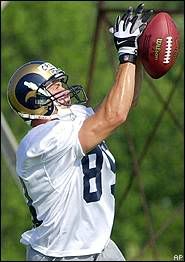
WR: Eric Crouch, St. Louis Rams, Pick #95, Round 3
Crouch’s college and pro careers were both almost over before they’d even started. In 1998, Crouch briefly left the Huskers after failing to be named the starting QB for the season opener. His college career rebounded, however, with a (controversial) Heisman Trophy in 2001 and a (controversial) national championship appearance the same year. Similarly, Crouch left training camp after the Rams used a third round draft pick on him in the hopes of converting him into a wide receiver. At the time, he yearned to be a quarterback and believed himself capable of outplaying both Kurt Warner and Marc Bulger. When Mike Martz failed to drive to Omaha to change his mind, Crouch’s first NFL attempt was over. Crouch then saw opportunity in Green Bay, but due to an outstanding training camp by an relative unknown named Favre, he was once again the odd man out and quit. In 2005, the Chiefs sent him to NFL Europe as a safety, and for reasons not yet known, he once again quit. It is safe to say, the most publicity and notoriety he has received in his professional career was when he stood onstage at Matt Leinart’s Heisman Trophy presentation in a mock-turtleneck and baggy pants. Upon hearing that the Downtown Athletic Club has now imposed a dress code, Crouch promptly informed them that he quit.
TE: Johnnie Mitchell, New York Jets, Pick#15, Round 1
Mitchell played just two seasons at Nebraska, but was a fan favorite known for his athletic catches and vibrant, confident attitude. In 1991 Mitchell was named to the UPI All-America Team, and was also an All Big-8 selection in 1990 and 1991. In the Citrus Bowl against Georgia Tech, he had 138 yards and a TD. With the New York Jets, Mitchell was considered at first to be one of the top TEs in the NFL, but over 5 years, he amassed just 16 touchdowns and slightly better than 2,000 yards. He has tried multiple comebacks, including a 2002 tryout with New Orleans, a 2003 tryout with Jacksonville and more recently, a 2004 stint with the Toronto Argonauts of the CFL.
OL: Mark Traynowicz, Buffalo Bills, Pick #29, Round 2
Mark was an imposing force at nearly 280 lbs and was one of the anchors on the best offense in college football history that included Mike Rozier, Turner Gill, and Irving Fryar. A year later in 1984, his feats garnered him First-Team All-America honors. Drafted as the first pick of the second round in 1985, Mark appeared in 14 games his rookie season. However, the USFL soon folded and Kent Hull became the starter at center. Mark would never start another game in the NFL again.
OL: Mark Behning, Pittsburgh Steelers, Pick #47, Round 2
Playing alongside Traynowicz for his entire collegiate career, Behning was also an integral piece to the success of our program in the early 1980s. In his senior year, Behning earned All-Big Eight and Academic All-Big Eight honors and helped lead Nebraska to a Big Eight championship and a Sugar Bowl win over LSU. However, Behning’s NFL career was less than admirable, and lasted just one year. Mark is now a high school coach in Denton, TX and it is interesting to note that he was drafted ahead of Herschel Walker (as the Cowboys secured his USFL rights), Mark Bavaro, Andre Reed, Kevin Greene, and Jack Del Rio.
OL: Toniu Fonoti, San Diego Chargers, Pick #39, Round 2
Literally clearing the way for Crouch’s 2001 Heisman campaign and his team’s championship campaign, Fonoti earned First-Team All-America honors and left school early for the NFL draft. Listed at 6’4 and 340 lbs, Fonoti was named to the All-Rookie team in 2002 and named All-Pro by sportsillustrated.com in 2004 (he sat out the 2003 season). Due to weight related injury and attitude issues, the Chargers were more fed up than Fonoti’s stomach and sent the reported 400 pounder to Minnesota, where he played in three games last year. As quickly as he can clean out the Golden Corral, he was sent to Tampa Bay where he currently sits second on the depth chart and continues to be plagued by injuries.
OL: Barney Cotton, Cincinnati Bengals, Pick #59, Round 3
A three sport athlete in high school, Barney Cotton was an imposing force with his 6-5 stature. After arriving at Nebraska, Cotton played special teams and offensive line as a sophomore, defensive tackle as a junior, and offensive guard his senior year which earned him a trip to the East-West All-Star game. After entering the NFL with the Bengals, Cotton was traded a year later to St. Louis where his career ended two years later with multiple knee injuries. After being saddled with the unenviable task of offensive coordinator Solich’s final staff, Cotton has since experienced success in the same role at Iowa State. In contrast with his mentor Solich, it appears that the harsh ending to the 2003 season has yet to lead Cotton into a life of public intoxication and (alleged) pill popping.
OL: Rob Zatechka, New York Giants, Pick #128, Round 4
While playing alongside the likes of Brendan Stai and Zach Wiegert, Zatechka earned seemingly every academic honor given to college athletes. Not only did he graduate with a 4.0, but he also earned Academic All-America honors and was an outstanding collegiate lineman. After arriving in New York, he was prematurely inserted into starting lineup in the 1995 season, giving his coaches too early of a look at what they had acquired. The highlight of a short-lived three year career was a kick return for five yards. Zatechka has since returned to medical school and is active in medical education in Omaha. Today, however, he is probably most recognizable as the television personality with the dubious task of assisting Travis Justice in his aimless quest for credibility.
Honorable Mention: IM Hipp, Lloyd Voss, Derek Brown, Rick Bonness, Tom Novak.
Subscribe to:
Comment Feed (RSS)

 Posts


