Double Extra Point has moved!

You should be automatically redirected in 5 seconds. If not, visit
www.doubleextrapoint.com
and update your bookmarks.

Showing posts with label Coaches. Show all posts

Thursday, July 30, 2009

2009 Division 1 College Football Coaches' Salaries

Following up with their recent Football Bowl Subdivision revenue blog post, the Orlando Sentinel is back at it again.

This time they are diving into college football coaches' salaries. And after some in-depth research, what Iliana Limon found is obscene.

For example, Alabama will pay Nick Saban and his Alabama assistants $6.5 million this season. She states that if they reach the SEC title game and go to a bowl, then the school will be paying the staff a minimum of $464,285 per game.

Limon claims that $6.5 million dollars is 'more money than 32 Football Bowl Subdivision (formerly Division I-A) programs spent on their entire teams in 2007-08.' Here is the list of what all of the non-BCS schools spend with those 32 schools denoted by an asterisks - LINK -.

Read the entire post from Iliana Limon by clicking here - LINK -.

(Click to see all of the Division 1 coaches' salaries here)

Coach, school Conf. Salary*
1. Pete Carroll, USC Pac-10 $4,400,000
2. Charlie Weis, Notre Dame Ind. $4,200,000
3. Nick Saban, Alabama SEC $3,900,000
4. Bob Stoops, Oklahoma Big 12 $3,800,000
5. Les Miles, LSU SEC $3,800,000
6. Jim Tressel, Ohio State Big Ten $3,500,000
7. Urban Meyer, Florida SEC $3,400,000
8. Kirk Ferentz, Iowa Big Ten $3,030,000
9. Mack Brown, Texas Big 12 $2,910,000
10. Bobby Petrino, Arkansas SEC $2,900,000
11. Mark Richt, Georgia SEC $2,900,000
T12. Rich Rodriguez, Michigan Big Ten $2,500,000
T12. Bobby Bowden, Florida State ACC $2,500,000
T12. Gary Pinkel, Missouri Big 12 $2,500,000
T12. Houston Nutt, Ole Miss SEC $2,500,000
T16. Mark Mangino, Kansas Big 12 $2,300,000
T16. Paul Johnson, Georgia Tech ACC $2,300,000
18. Greg Schiano, Rutgers Big East $2,250,000
T19. Frank Beamer, Virginia Tech ACC $2,100,000
T19. Butch Davis, North Carolina ACC $2,100,000
T21. June Jones, SMU C-USA $2,000,000
T21. Lane Kiffin, Tennessee SEC $2,000,000
T21. Gene Chizik, Auburn SEC $2,000,000
24. Al Groh, Virginia ACC $1,875,000
25. Bo Pelini, Nebraska Big 12 $1,851,000

**Source: CoachesHotSeat.com, gathered from contracts and media reports

Thursday, April 16, 2009

College Football's Top 100 Coaches

The fine Dixie Fried Sports website has compiled their list of the Top 100 coaches in college football today. They emphasize today as the coaches' all-time resumes have absolutely nothing to do where they stand on this list. Bo Pelini came in at #23 with Bob Stoops (#4), Mack Brown (#9), and Mike Leach (#15) as the only Big XII coaches ranked ahead of him. The best part about the list - Bill Snyder came in at #31 while Gary Pinkel came in at #41. Keep being awesome guys. To read the entire rankings, click here. And here's what they had to say about Pelini,

#23. Bo Pelini (10-4 at Nebraska and overall)- In 2019 when we make this list Pelini might be in the top 5. There are few defensive minds better than Pelini and soon it will start to show in Lincoln. The Blackshirts will be back and Pelini will have Nebraska in a BCS bowl very soon. Pelini has led top defenses at Nebraska, Oklahoma, and LSU as a DC. Toughness is back in Lincoln and will stay there for a long time.

2019? Fellas, you know we can't wait that long.

Friday, April 10, 2009

Jim Leavitt's 40-Yard Dash

It looks like a diet consisting of candy bars and Mountain Dew is now becoming the new breakfast of champions. South Florida coach Jim Leavitt was challenged by the sports information department to run an official 40-yard dash yesterday, which is part of a promotion for the USF spring football game. The 52-year-old Leavitt clocked in at a pretty impressive 5.72 seconds. Students will participate in a mock combine before the spring game and will receive a free t-shirt if they can beat Leavitt's time. The coach claims to have been around a 4.7 during his playing days at Missouri. Lace 'em up, Bo. And you might want to get about 20,000 t-shirts ready for print.

Thursday, February 26, 2009

Will Jim Leavitt Come Calling On Mike Ekeler Again?

Illinois defensive coordinator Dan Disch has turned down Jim Leavitt's offer to become the new defensive coordinator at South Florida.

It appears, however, Mike Ekeler is already out of the picture. According to the Brett McMurphy at Tampa Bay Online, Ekeler turned down Jim Leavitt before the job was offered to Dan Disch. Leavitt has also interviewed former Cincinatti coach Joe Tressey, who was never offered.

Coaching at Nebraska with the Pelinis certainly would be a dream job for almost any position coach in college football. Emphasize the word position coach. I'm not exactly sure why Ekeler would turn down a coordinator position in the Big East Conference with an old friend that will clearly be more lucrative than his $120,000 salary at Nebraska. (According to the LJS, Wally Burnham, who was the defensive coordinator that just left South Florida for Iowa State, was making $220,000.) This isn't exactly a lateral move for Ekeler. Jim Leavitt, who is 52 years of age (surprising, huh?), will probably be around for as long as he wants at South Florida which means that the head coaching job there is probably not very realistic down the road for Ekeler. Still, it's all about moving up the ladder if you are Ekeler and want to be a head coach someday.

If Ekeler had any second thoughts about turning down the job the first time around, then now is his golden opportunity to seize the moment. Ekeler is a great coach and a great recruiter, and we need him at Nebraska for our own selfish needs. Chances like this don't come around the corner all the time, but I'll be shocked if he changes his mind the second time around.

Wednesday, February 25, 2009

Mike Ekeler Remains Grounded In Nebraska

South Florida coach Jim Leavitt has decided not to jump on Mike Ekeler as his new defensive coordinator. Although Ekeler interviewed last Saturday and was thought to be a leading candidate, Leavitt will offer the Bulls' opening to Illinois co-defensive coordinator Dan Disch. Disch, who was in his fourth year at Illinois, coached with Ron Zook at Florida and was a longtime high school coach in Jacksonville, FL, where he is considered to be an ace recruiter. Disch will be replacing 67-year-old Wally Burnham, who took the same job at Iowa State to coach with newbie Paul Rhoads. Burnham is considered to be a great catch for Rhoads at Iowa State as he has worked 23 seasons at Florida State, South Carolina, and South Florida and has one National Championship ring with the Seminoles.

This all means that Head Cheerleader/Assistant Coach/Linebackers Coach Mike Ekeler won't be going anywhere for the 2009 season. Okay Ekeler, since you are no longer going anywhere, why don't you head down to the local tattoo parlor and have 'David Oku' temporarily inked to your forehead kind of like you did with Will Compton. It's the least you can do after threatening to leave.

Monday, January 05, 2009

Is there an 'F' in Stoops?

A recent study released by The Institute for Diversity and Ethics in Sport (TIDES) detailing graduation rates for this year's college bowl teams has been posted on several websites.

At the top of the list of programs graduating a high percentage of players are the usual suspects. Notre Dame, Navy, Air Force, Boston College, Vanderbilt, and Northwestern are all at the top of the list. Nebraska is near the top graduating 78% of its football players.

The three programs graduating the lowest percentage of players are (in order) Arizona, Hawaii, and Oklahoma. All three graduate less than 46% of their players. Congrats to the Stoops brothers for making sure they put the "student" in "student-athlete." Having some of the lowest graduation rates makes some sense for programs placing a high percentage of underclassmen in the NFL.

That might explain how Oklahoma is ranked so low. But Arizona? That program's been doomed since Sports Illustrated featured the "Desert Swarm" defense on the cover of its 1994 college preview edition.

On a positive note, Mark Stoops, currently Mike's defensive coordinator, looks like a perfect fit at Hawaii, should that job ever open up.

Friday, October 24, 2008

The Brandon Rigoni vs. Mark Manning Duel

This is great. Former Husker special teams standout Brandon Rigoni and current Husker wrestling coach Mark Manning had a battle for the ages yesterday at practice. The bet was that Manning could not stop Rigoni from scoring five times in five attempts from the three yard line.


I don't know about you, but I didn't think it was remotely possible that Manning was going to stop that missile coming at him full speed. I clearly remember when all 180 pounds of Rigoni used to single handily blow up opponent's wedges on kickoffs in his sleep. Although Rigoni put together three highlights in his first three attempts including a four yard front flip, he clearly forgot the objective of his mission on the fourth attempt: don't get clowned by the wrestling coach in front of the entire football team. You got to love how Doc Sadler was there in attendance with his suit and tie showing his support. You also got to love how Tom Osborne was not only there, but there to hand out the trophy. Amazing how much the atmosphere has changed in and around the football program in less than an year.

Well done Mark Manning.

Friday, October 17, 2008

Coaching 101

It's unfortunate that Bobby is the only Bowden left nowadays. Nobody does it better.

Thursday, August 23, 2007

Scouting USC – Inside Pete Carroll


From my favorite USC site Trojan Football Analysis.

What he learned from John Wooden while out of coaching:
“It was a pretty profound moment — one thing in that book just hit me,” said Carroll, now entering his seventh season with the Trojans. “Coach Wooden talked about how it took him 17 years to win his first national championship, but when he figured it out he won 10 national championships in the next 11 years.

“It hit me because once he ‘got it,’ he had it down. That’s what I set out to accomplish.”
On the foundation of his philosophy:
Through his thought process, a main focus rose to the top — competition — and it’s been the foundation of the program ever since.

“When I really soul-searched, I realized that when it all came down to it, I was a competitor,” Carroll said. “That’s me, it’s what I’ve been my whole life. I had to be true to who I was, I couldn’t pretend to be someone or something I’m not. So the central theme had to be what I believed in and lived out in my life.”
On his three basic team rules:
At the first meeting of every spring and fall, Carroll lays out three rules for his team, which form the foundation for all actions and attitudes he expects his players to follow.

One, protect the team. Two, no whining, no complaining, no excuses. Three, be early.

“I really like the ‘three rules,’ because it makes everything very, very clear to our players and coaches,” Carroll said. “It’s another idea I got from Coach Wooden, and I’ve seen it work exceptionally well.”
On the importance of turnovers:
Carroll also emphasizes his motto, “It’s all about the ball.” Causing turnovers on defense and preventing them on offense are almost always the reason for a win or loss. The importance Carroll puts on the ball has developed the Trojans into what could arguably be called the best turnover team in the history of football, as the Trojans have a plus-94 turnover ratio in the last six years.

“When you force a lot of turnovers and don’t give the ball up, you’re putting yourself in position to win every game,” Carroll said. “If you make the game all about what you can control, then the outcome is essentially in your hands every time.”
Accentuating the Positive:
Another key aspect to Carroll’s ideology is his emphasis on maintaining a positive attitude and approaching all challenges and triumphs as an opportunity to grow and get better. “Eliminate all negatives,” Carroll says.

“I learned from [former North Carolina State basketball coach] Jim Valvano that you should never allow for negatives,” Carroll said. “It doesn’t matter what the issue is or what the obstacle is, there are no negatives. And through that, you can look at everything as a special opportunity to improve, reflect on, or just sit back and enjoy.”
On Practice:
We practice fast and compete every minute so that our players will be more than ready for the game,” Carroll said. “What they see at practice is hopefully going to challenge us more than anyone else we’re going to play against.

“It’s simple: Compete and put in the effort at practice, and gameday will just fall into line.”
The Difference?
Focusing on taking games one play at a time, one series at a time, one quarter at a time — another important element to Carroll’s philosophy — is emphasized at practice, along with finishing every one of those plays, series, quarters to the very end. “Finish” has become a motto of the strength and conditioning program, as well as the team.

Thursday, June 21, 2007

Ranking the Coaches Based on...Um, Coaching

I'm sure many of you remember Tom Dienhart's attempt at ranking all of the BCS coaches. Like most of Dienhart's columns the piece seemed to be based on little other than personal opinion. That's fine as he gets paid to have an opinion, but there had to be a more scientific approach to the endeavor.

Well, it turns out there was a better approach, like the one taken by LD at the The Corporate Headquarters of the San Antonio Gunslingers.

LD based his rankings on several key factors:

Longevity
National Titles
Conference Titles
Winning Percentage
Winning Percentage As Against School's Historic Winning Percentage

I've said it before, but this is another example of how the mainstream media gets outdone by bloggers. Anyway, you can see the spreadsheet of LD's rankings here.

Here are some of LD's comments related to Nebraska and Bill Callahan
Winning Percentage As Against School's Historic Winning Percentage:

Biggest upgrade by Dienhart from where a coach would be rated by this objective category: Bill Callahan (from 50th up to 21st).

Coaches upgraded by Dienhart by more than 10 spots (my guess at a reason, and here I don't consider a bad program as a good reason since it's already accounted for): Hawkins (small sample), Bobby Johnson (???), Bill Callahan (???), Mark Mangino (???), Greg Schiano (???), Jim Leavitt (Shouldn't be listed here - he's the only coach at the program, so his comparison to history is neutral), Houston Nutt (???), Lloyd Carr (title), Kirk Ferentz (???), Tom O'Brien (???), Tommy Tuberville (???, near-title?), Frank Beamer (longevity), Nick Saban (title), Mack Brown (title), Rich Rodriguez (???), Jim Tressel (title).

Looking at the various objective criteria, I think Dienhart overrates and underrates a few coaches, based upon their accomplishments.

OVERRATED: Mark Mangino, Bill Callahan, Bobby Johnson, Rich Rodriguez, Kirk Ferentz, Tom O'Brien.

UNDERRATED: Phil Fulmer, Ralph Friedgen, Mark Richt, Charlie Weis, Jeff Tedford, Les Miles, Tommy Bowden, Bret Bielema, Tyrone Willingham, Karl Dorrell, Bill Doba.

A few more specific nits to pick considering all the categories discussed:

Houston Nutt at #20 isn't defensible. Guys behind him that best or equal him in every category: Tedford, Richt, Leach, Friedgen, Fulmer, Tiller, Bielema, Miles. Nutt's objective rankings put him right in line with Tommy Bowden, whom Dienhart ranks 47th (though, arguably he shouldn't be that low).
Matt at Statistically Speaking also introduced another variable into attempts at rating coaches. He created a formula that looks like this:
Win % Last Season (50%) + Win % 2 Yrs Ago (20%) + Win % 3 Yrs Ago (10%) + .500 (20%)

The four components are winning percentage for the previous three seasons; with each season decreasing in importance as the distance from the current season increases and the final component is a winning percentage of .500 as teams tend to trend towards .500. Including this component ensures we don’t penalize coaches coming off undefeated seasons because improving upon a 100% winning percentage is impossible. Additionally, we don’t reward coaches who go winless because we assume they will improve at least marginally. Next we just subtract the team’s expected winning percentage from their actual winning percentage. This number is the coach’s rating.
Here are the best and worst coaches in each conference according to Matt's formula:

Best

ACC
Jim Grobe (Wake Forest) +.389

Big East
Greg Schiano (Rutgers) +.340

Big 10
Bret Bielema (Wisconsin) +.235

Big 12
Dennis Franchione (Texas A&M) +.215

Pac 10
Mike Riley (Oregon State) +.208

SEC
Rich Brooks (Kentucky) +.309

Conference USA
Todd Graham (Rice) +.296

MAC
Frank Solich (Ohio) +.271

Mountain West
Bronco Mendenhall (BYU) +.372

Sun Belt
Larry Blakeney (Troy) +.166

WAC
Dick Tomey (San Jose State) +.392

Worst

ACC
Chuck Amato (NC State) -.294

Big East
Randy Edsall (Connecticut) -.203

Big 10
Pat Fitzgerald (Northwestern) -.205

Big 12
Dan Hawkins (Colorado) -.367

Pac 10
Walt Harris (Stanford) -.354

SEC
Mike Shula (Alabama) -.185

Conference USA
Tommy West (Memphis) -.427

MAC
Shane Montgomery (Miami, Ohio) -.467

Mountain West
Chuck Long (San Diego State) -.181

Sun Belt
Darrell Dickey (North Texas) -.127

WAC
Jack Bicknell (Louisiana Tech) -.329

Obviously neither of these systems is perfect, but they have to be better attempts than what Dienhart and most pundits provide.

Friday, March 02, 2007

The Borders of Husker Nation

This has truly become the off-season of our discontent.

The fibers of Husker Nation have been tattered, if not torn by a bleak mid-winter of scandal, change and scorn.

Philosopher and consciousness expert Ken Wilber postulates that every decision we make, every action we take is based on the construction, (whether conscious or unconscious) of boundaries. Boundaries between you and I, between us and them, between similar and dissimilar, between war and peace, between life and death. Existence, then, as we know it is a process of drawing boundaries. At first blush this act seems both inevitable and harmless. Unfortunately, a natural consequence of this is the creation of opposites.

Expectations or recollections. Solich or Callahan. Privacy or Disclosure. Pederson or Shatel. The Past or the Future.

Husker Nation must now recognize that each of these boundary lines also becomes a potential battle line. Every hire and every fire arms the divergent sides. Every coming and every going strengthens conflicting opinions. The new reality is that to draw a boundary, is to prepare oneself for conflict.

The problems facing Husker Nation are problems of boundaries and the opposites they create. Our usual way of solving these problems is to attempt to eliminate one of the opposites. We handle the problem of good vs. evil, by trying to exterminate evil. We handle the problem of change by gripping tightly to the status quo. The point is that we treat the boundary as real and then manipulate the opposites created by this boundary. We never question the existence of the boundary itself. Because we then believe the boundary to be real, we steadfastly imagine that the opposites are irreconcilable, separate, forever set apart.

But what if the boundaries aren’t real? What if by seeking to accentuate the positive and eliminate the negative, we have forgotten entirely that the positive is defined only in terms of the negative? In other words, while the opposites might indeed be as different as night and day, we must recognize that without night we would not even be able to recognize something called day. Without Nebraska football’s past, its future would be unimaginable. Without Devaney, there is no Osborne. Without Osborne, no Solich. Without Solich, no Callahan.

However vividly the differences between these opposites may strike us, they nevertheless remain completely inseparable and mutually interdependent, for the simple reason that the one could not exist without the other. There is no inside without an outside, no up without down, no win without loss, no pleasure without pain, no life without death. This is what Nicholas of Cusa called the coincidentia oppositorum – “the coincidence of opposites”. What we thought were totally separate and irreconcilable opposites turn out to be complimentary aspects of one and the same reality.

Thus, to destroy the negative is, at the same time to destroy all possibilities of enjoying the positive.

Like it or not Nebraska football’s past and its future, like all opposites are fated to intimately embrace one another for all time.

The point is not to separate the opposites and make progress, but rather to unify and harmonize the opposites, both positive and negative, by discovering a ground which transcends and encompasses them both. This common ground refers to an ultimate reality that is a union of the opposites.

What then will serve as Husker Nation’s union of opposites? Firing Callahan? Firing Steve Pederson? Tom Osborne as A.D? The easy answer is winning. Win enough and the opposites will be realized as one. With a sixth national title, the past will become the future. Discord will melt into concord. Battles will become celebrations, and old enemies will become allies. Then, and perhaps only then, will we find ourselves in a position to make friends with all of Husker Nation, and not just one half of it.

*Special mention needs to be made of the work of Ken Wilber, without this I would have been unable to illustrate these points.

Wednesday, February 28, 2007

Nebraska Hires Rudolph


Coach Callahan completed his re-tooled coaching staff with the hire of Joe Rudolph as TE coach. Of the hire, Callahan says:
"Joe has a strong work ethic and will bring great energy to our staff. He has an excellent football mind and history of success. He was a part of winning teams on both the collegiate and professional level as a player and has been part of one of the top programs in the country the last three years."
I think that last sentence is an important component of this hire. One thing our staff seems to be lacking is overwhelming success at the college level. We know that Callahan, Cosgrove, Elmassian, Busch and now Rudolph spent time at Wisconsin in the 90s when the Huskers, Seminoles and Hurricanes were CFB’s elite. The Badgers have a solid program but have never been world-beaters. Couple that with Callahan’s tepid start and you find a staff that is perhaps short on swagger (for lack of a better term). I don’t think you can overestimate the importance of surrounding our team with “winners”. It may seem trite, but winning and the attitude it brings with it are often contagious.

Given that one of Rudolph’s main tasks last year at Ohio State was to motivate the team to work hard in the weight room and maintain focus through a 12-1 season, he should have a good idea of “what it takes”. Okay, enough triteness.

Rudolph’s nondescript official statement says:
"I am very grateful for the opportunity to join the Nebraska football program. I hope to complement the outstanding coaching staff and the elite football tradition at the University of Nebraska. I am excited and plan to hit the ground running."
Looks like another good hire and I hope he finds us a weapon at the TE spot.

Monday, February 26, 2007

Monday Bits and Pieces

Before we start, I have to admit it is getting a little lonely around here. Remember when DXP had a bunch of lively contributors? What the hell happened? I heard from Sammy Vegas this weekend and he will be returning shortly. What about T. and/or A. Rose? You guys game for some pieces this off-season? Oh and Dr. D if you can take a break from the "Fornication Vacation" you'll always have a spot too. Just let me know guys.

· The LJS is reporting that Joe Rudolph is perhaps the leading candidate for the TE coaching vacancy. Rudolph played for Wisconsin (while Callahan coached there) and earned first team All-Big Ten honors twice and helped the Badgers win the Big Ten and Rose Bowl as a senior. In the NFL, he spent two seasons with the Philadelphia Eagles and two with the San Francisco 49ers before injuries cut his career short in 1998. Rudolph is currently a member of the Ohio State strength and conditioning staff, but was formerly a GA with the Buckeyes who assisted with the offensive line.

· The Day 4 NFL Combine results are posted and Brandon Jackson seems to have had a pretty decent day. He won’t be happy with his 4.57 time in the forty, but he did show good explosiveness and change of direction with a 4.14 time in his 20-yard shuttle. Jackson also posted a 37’ inch vertical 10’2” broad jump. I’m still thinking he is a 3rd or 4th round pick.

· The Seattle Seahawks have tagged former Husker Josh Brown as their franchise player. Brown is the only kicker among this season’s seven franchise players. He led the league with four game-winning FGs in 2006 and is quickly becoming the leagues top clutch kicker. By rule the Seahawks will be forced to pay Brown just more than $2 million.

· Finally, we see what serves as a Texas-sized celebration around these parts. Apparently this is a group of Longhorn fans throwing down after the win over OU. I don’t think we really need to worry about that whole “Keep Austin Weird” movement.

Tuesday, January 30, 2007

Bill Walsh on Interviewing Coaching Candidates

Sitting down with an individual for a limited length of time and determining whether a candidate has the requisite capabilities is one of the most ambiguous, subjective and challenging tasks that a head coach or administrator will face. The individual interviewing the candidate must know what he is looking for and how it will be determined whether he finds it.

Of this process Walsh states:
"Even the most seasoned, veteran head coach can have a tough time determining if an individual has the abilities he is looking for in a position coach or has exemplary communication skills and gives good interviews. This dilemma is why head coaches often hire people with whom they have worked before or individuals who have been recommended by someone in whom they have a great deal of trust.

When developing a systematic plan for conducting interviews to hire staff members, the head coach should consider the following factors:

· At some point, a single individual will have to make the choice of whom to hire (like most sound decisions).

· The more people who are included in the hiring process, the greater the likelihood that either a superfluous number of criteria will be added to the approach employed by the organization for decision making or the effectiveness of the undertaking will be diluted. This situation is particularly true when colleges look to hire a head coach. (Maybe Steve Pederson isn’t so crazy after all).

· The process of interviewing and hiring an assistant coach will be relatively easy if the individual conducting the interview (and making the hiring decision) has a history or a working relationship with a candidate who is well-suited for the position.

· If the situation, however, involves a candidate with whom the organization has little or no familiarity, it is imperative that a specific plan be established regarding whether a candidate has those attributes, and how the organization can make the process equitable for all the interviewees so that the procedures are not unknowingly biased toward one candidate.

· A precise set of criteria detailing what the position calls for must be established. If such criteria are not identified, the head coach (or whoever is conducting the process) may become distracted by the different skills and capabilities of the individuals who are being interviewed and may lose sight of the specific position he is trying to fill.

· The basic qualifications of each candidate must be assessed. This step can be accomplished in several ways. For example, his background should be closely scrutinized to determine the level of success he has enjoyed as a coach, the caliber of competition the teams which he has coached have faced, the level and type of responsibility he has performed as a coach, etc.

· An organization must make every effort to ensure that the different candidates are evaluated on an even field. For example, the unique qualities of a particularly talented candidate may be overlooked simply because the individual has been working for a team that has an inferior win-loss record compared to those of other candidates."

Monday, January 29, 2007

Filling the Remaining Spot on the Coaching Staff

So with Shawn Watson officially being promoted to offensive coordinator and QB coach, and Sean Callahan of Huskers Illustrated reporting that Ted Gilmore is expected to be named recruiting coordinator, Nebraska’s coaching staff lacks just a TE coach. I thought that this news would give me a chance to look into the process of putting a coaching staff together. This also gives me another opportunity to turn to my man-crush Bill Walsh and to his book, which I’m currently reading - Finding the Winning Edge. This book is like the Holy Grail when it comes to coaching football. It covers every, and I mean every detail of the life of a coach, from organizing a staff to working with the media. Although the book is out of print I managed to pick up a used copy that once belonged to the Jamaica, Queens Public Library.

First like any CEO, a head coach must be able to project the future staffing needs of the organization. This is crucial as over time, openings for assistant coaches will occur for any number of reasons (e.g., individuals take a position with another team, some retires, a coach is fired, the size of your staff increases, etc.). Walsh notes that:
“Each time an opening exists and is filled, a certain level of transition among the previous staff members typically transpires. If this transition is not handled properly, the situation can be very divisive and disruptive when the individuals are passed over for a particular position they wanted or reassigned from a job they preferred”.
Next it might be useful to define the role of the TE coach, according to Walsh:
“This person oversees the establishment, development and implementation of the game plan as it pertains to the tight ends. He works in association with the offensive line coach and the receivers coach. His primary responsibility is to work with the tight ends on their blocking techniques and skills.”
Once these basic responsibilities have been established a coach needs to identify the desired qualifications of staff members. This can be a difficult proposition. One the one hand, the staff must have the technical knowledge of the game that is necessary to ensure that every player performs up to the best of his natural attributes. On the other hand, the staff must possess the personal attributes that enable them to collectively focus their energies on a common goal. In addition, it is helpful to consider the diversity of your staff so that each person offers a somewhat different combination of traits, capabilities and experiences. Walsh highlights five major qualities of prospective assistant coaches:

1. A fundamental knowledge of the mechanics of his position. An assistant coach must be technically competent. His competence level must be such that he can work with each player on an individual basis as needed.

2. Ability to communicate. An assistant coach must be able to communicate with the players in a relaxed, yet authoritative manner. Such a quality is the fundamental basis of an assistant’s ability to effectively teach and interact with his players – perhaps the two key responsibilities of every assistant coach.

3. Ability to evaluate and project talent. Assistant coaches must evaluate the abilities and the performance potential of those players with whom they are working.

4. A relatively high level of energy. Assistant coaches must exhibit an appropriate level of energy that enables them to be upbeat, motivated and animated while in the presence of the players and their fellow employees. It is not unusual for a group of players to collectively take on the personality of their position coach.

5. Loyalty. Assistant coaches must exhibit loyalty at all times, both to the head coach and to their fellow assistant coaches. While a head coach always expects his assistants to display unconditional loyalty to him, their sense of loyalty should also extend to the other staff members.

That should hopefully shed some light on part of the process facing Coach Callahan as he looks to fill the final spot on the staff. I’m planning on writing a bit more on putting together a staff including the interview process and a few other details as the week progresses.

Friday, January 26, 2007

Norvell to UCLA


Offensive Coordinator and QB coach Jay Norvell has accepted the Offensive Coordinator job at UCLA. Interestingly, the spot was vacated by the firing of another coach with Nebraska (Wesleyan) ties Jim Svoboda.

Normally losing a coach this close to Signing Day would be troublesome. In this case, however, I don't expect it to have much impact. Norvell was a solid recruiter, but not spectacular and has not been the contact for many of our big-name recruits over the past couple of years.

My sense is that Shawn Watson will become the Offensive Coordinator, but much like in Norvell's case the position will mainly be a title. Callahan will likely remain in charge of game planning and playcalling.

First name I'll throw out there to fill the vacancy on the staff is Dave Roberts. His name has come up time and time again, and he is a very respected recruiter. I'll give some thought to some other candidates and update this over the weekend.

*Update - Another name to consider is Eric Roark. Roark is currently the recruiting coordinator at SMU and also coaches DEs. He has fantastic connections in Texas and would be a big help recruiting that state. Roark also played for Jimmy Johnson at Oklahoma State.

Thursday, December 14, 2006

New Defensive Line Coach - Buddy Wyatt


It's official. Nebraska has hired Buddy Wyatt as the new DL coach. Wyatt was in his fourth year as a member of the Tide coaching staff before Mike Shula was fired. In 2006, Alabama finished the year 18th nationally in scoring defense and 29th in total defense. The Tide finished the 2005 season ranked first in scoring defense, second in total defense, fifth in pass defense and pass efficiency defense and ninth in rushing defense.

Wyatt is a native of Victoria, Texas, and played at Stroman High School where he lettered in football, basketball and track. He graduated in 1985 and attended TCU earning four letters as a defensive lineman for Coach Jim Wacker. As a senior he tallied 46 tackles and four quarterback sacks. He graduated with a degree in education in 1989. Following his career at TCU, Wyatt played two seasons of professional football. In 1991, Wyatt began his coaching career by returning to TCU as a graduate assistant working with the defensive line in 1991.

Wyatt has connections with both Tim Cassidy and Shawn Watson. Cassidy and Wyatt worked together under R.C. Slocum at Texas A&M from 1999-2002. Wyatt was also on staffs at both Northwestern and Colorado with Watson.

Wyatt's Coaching History
2003-present Alabama, Defensive Line
2000-2002 Texas A&M, Defensive Line
1999 Colorado Defensive Line
1997-98 Northwestern Defensive Line and FG & PAT Defense Special Teams
1996 Oklahoma State Defensive Line
1992-95 Minnesota Defensive Line and Special Teams
1991 TCU Graduate Assistant, Defensive Line
Like Blake, Wyatt's strength appears to be his energetic and affable personality. His profile on Scout.com, describes him as "an excellent recruiter and well-liked coach." Nebraska could also benefit from his recruiting connections in the south.

Wednesday, December 13, 2006

John Blake Leaving


So John Blake is moving on to the greener pastures of Chapel Hill. As a result, the sky is falling and the evil plague of "change" is sweeping over Lincoln and surrounding communities. I appreciate all that Blake has done during his time in Lincoln, especially on the recruting trail, but this day was inevitable.

Here is the inexorable, but unofficial list of possible candidates soon to be seen on message boards and discussed ad nauseam, until a far more appropriate replacement is named:

Bo Pelini
Trev Alberts
Rich Glover
Larry Jacobson
Jason and/or Christian Peter(s)
Monte Kiffin
Marv Sanders
William "the Refrigerator" Perry
Chuck Amato
Kevin Steele
John Parella
Neil Smith
Mark May
Bob Brown
Moe Iba
Charles Woodson
Tony Samuel
Dan McCarney
John Gruden
Patrick Deuel
Carol Frost
Bruce Smith
Gary Barnett
Larry the Cable Guy
John Melton
Jeff Bowden
Watson Brown
Cedric the Entertainer
Tommie Frazier

Wednesday, December 06, 2006

What's Eating at Coach Callahan?


Everyone knows that Coach Callahan has blamed himself for the loss to Oklahoma in the Big 12 Championship Game. By now, this has been covered by just about everyone under the sun. One thing I haven’t seen though is a cogent discussion as to why Callahan would point the finger at himself.

After all, he didn’t underthrow receivers, miss blocks, or get beat by Malcolm Kelly. That’s not the role that coaches play. As Brian Billick states, “as a coach, you will not catch a single pass, throw a single block, or score a single touchdown this season. Nor will you, on a consistent basis, make that singularly brilliant play call that wins the game.”

And now, we even see Callahan’s players stepping forward to shoulder the blame.
"We all know it wasn't his fault," said Taylor, who threw three interceptions and lost a fumble. "We played the game. I know it's not his fault that I can't hit Nate Swift on a seam route when he's wide open. You've got to put the blame on the players. But he's a classy guy and he's a great coach, so naturally he's going to take the blame for it, even when we know that we made mistakes that we shouldn't have made."
So all of this begs the question – why is Callahan taking this loss so personally?

My first thought, is that perhaps Callahan is becoming entrenched in the culture that is Husker football. Let’s not forget this is the same guy who so famously uttered the “one game, one season,” remark just two short years ago. There is little doubt Callahan is more invested in the program now. We saw a glimpse of this a year ago, when he emerged teary-eyed following the victory over Colorado, but now his disappointment speaks volumes. Each week the Tunnel Walk echoes the sentiments – “I play for Nebraska”. Perhaps his reaction is simply evidence that Callahan has more fully internalized the notion – “I coach Nebraska.”

A second explanation might be found by examining Callahan’s coaching lineage. A pedigree that is superbly laid out in the following illustration.
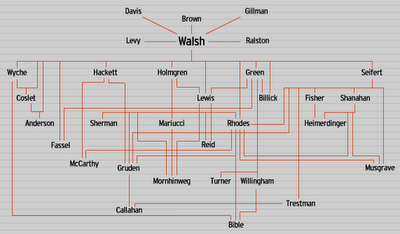

Atop that illustration you see Bill Walsh’s name and toward the bottom, Bill Callahan’s. Although Walsh’s connection to Callahan seems somewhat removed, his influence might be less distant than you think. Obviously Callahan and Walsh are linked by way of the West Coast Offense. It is important to note, however, that the WCO is more than a system of plays. The major key to Walsh’s WCO was less in the actual Xs and Os than it was in the innovative approaches he took in preparation, installation and implementation of those fundamentals. The WCO was never meant to be just a series of runs and passes that emulates the success of the San Francisco 49ers during the 1980s and 1990s. Instead, Walsh’s structure was based on specific teaching methods that carried a team systematically from the installation of the offense in Fall camp, to weekly installation of the game plans at practices, to the actual implementation of the game plan on game days. A recurring theme then is preparation, preparation and preparation.

What then does this have to do with Callahan and the blame game? For further help with this let’s look at a Harvard Business Review (January, 1993) interview with Bill Walsh. In outlining his philosophical approach to preparing successful football teams, Walsh states:
“A system should never reduce the game to the point where it simply blames the players for failure because they did not physically overwhelm the opponent…the responsibility for the success of the team starts with the coach, who develops the plan, that is then executed by the players – who are extremely well-prepared.”
In Monday’s conference call, Callahan’s exact quote was:
"I was disappointed in everything I did. I could have done a better job. I just didn't do enough.”
This sounds as though he is blaming himself for failing to fully prepare his team for everything they might see against OU, or for failing to have a contingency plan in place should they fall behind early, or have difficulty sustaining drives.

Similarly, in the Harvard Business Review interview Walsh is also quoted as saying:
“You need to have a plan for even the worst scenario. It doesn’t mean that it will always be successful. But you will always be prepared and at your best.”
According to Brian Billick, another Walsh disciple, this is important because:
“The more your players can gain a sense of confidence that they are prepared for anything that might come up, the less likely they are to feel 'physically overwhelmed,' even if their opponent is capable of doing just that.”
Lastly, Walsh emphasized the importance of thoroughly analyzing one’s opponent and making decisions in the cool and calm of one’s office, rather than on the fly and from the sidelines.
“Making judgments under severe stress is the most difficult thing there is. The more preparation you have prior to the conflict, the more you can do in a clinical situation, the better off you will be.”
Could there be a more stressful situation for a coach than trailing 14-0 in a conference championship game? How might that duress have impacted some of Coach Callahan’s decisions? Might he fault his own preparation for the influence it had on a choice to go away from the run and to throw 20 consecutive passes?

And I’m not questioning these decisions; I’m simply trying to get to the bottom of what is eating at our coach this week. The best I can come up with is that Callahan is feeling more at home with the breadth of his position and the investment of the coaches, players and fans. In addition, it signals an adherence to the roots of his coaching philosophy – one that emphasizes commitment, preparation and accountability.

Monday, December 04, 2006

It is Indeed a Virtue

With the ongoing CFB coaching caruosel and coming off a disappointing loss, people are going to once again start asking for heads to roll in Lincoln. I’m not sure why Cosgrove seems to be the coach de jour, given that his gameplans were actually pretty solid against the top two teams in the Big XII South. But anyway, here is a poignent parable to keep in mind from the always enlightening SportsProf:
"You have to remember one of the greatest examples in patience, both by the coach and the school. In the late 1940's, the hoops coach at Purdue was looking for a new job. The University of Minnesota had him all but signed up, but they delayed inexplicably, and a nice athletic director at a state university in California pursued the Purdue coach and offered him the men's hoops job. It wasn't that prestigious a job, there wasn't much tradition, the basketball court was an embarrassment, in an old building, and the coach sometimes had to sweep the floor, but the Purdue coach took it. Gradually he worked toward building a better program, and it wasn't until 1965 -- 15 years after this coach got to this California school, that the coach won his first national championship, when he was something like 54 years old. The coach? John Wooden. The school: UCLA. And we all know that Mr. Wooden won a bunch of titles after that."
Side note – If the state didn’t have crazy weather and football discontentment, what the fuck would Nebraskans talk about?